Tag: wireless

  • Xiaomi Launches Wireless AirDots And New Mi Notebook Air

    Xiaomi Launches Wireless AirDots And New Mi Notebook Air

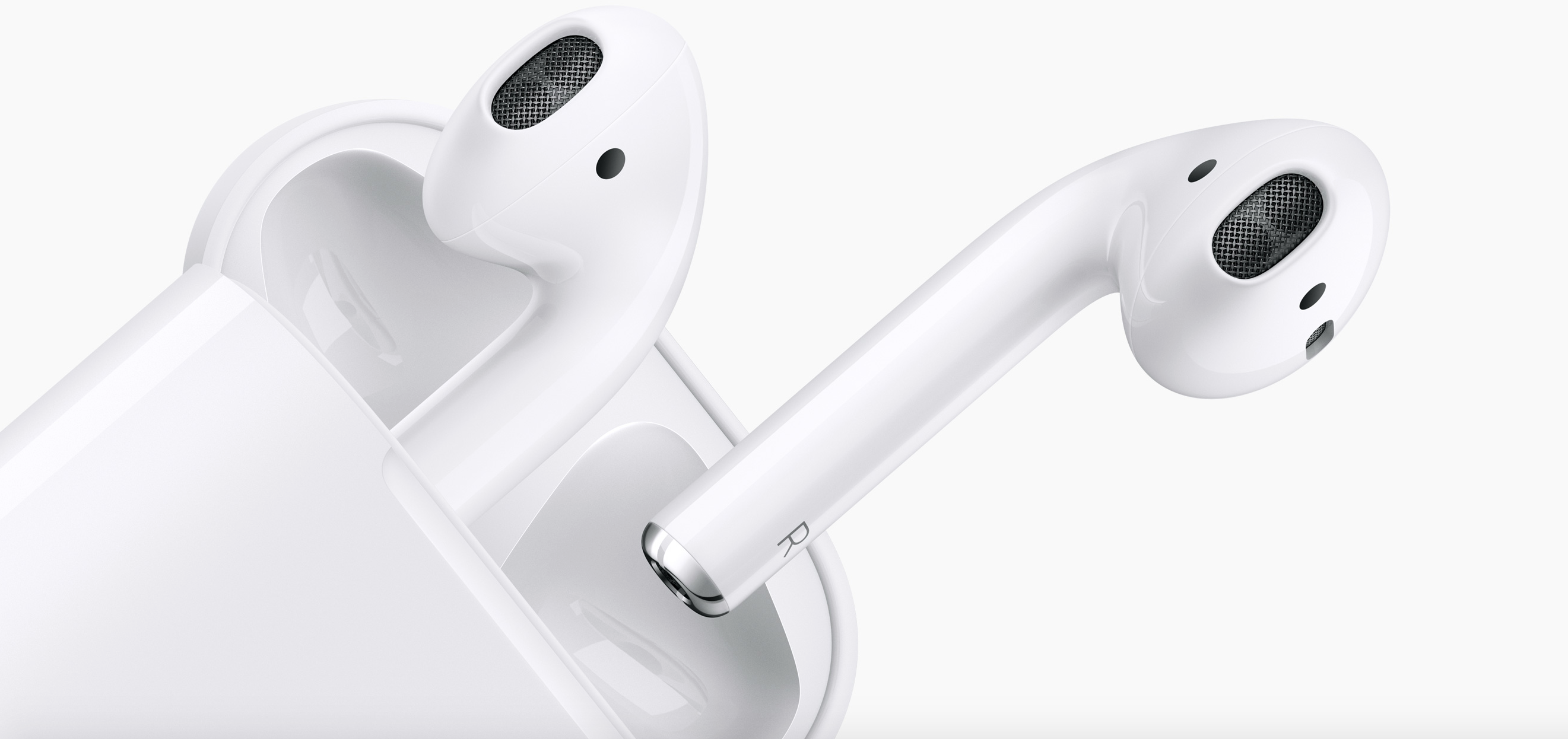
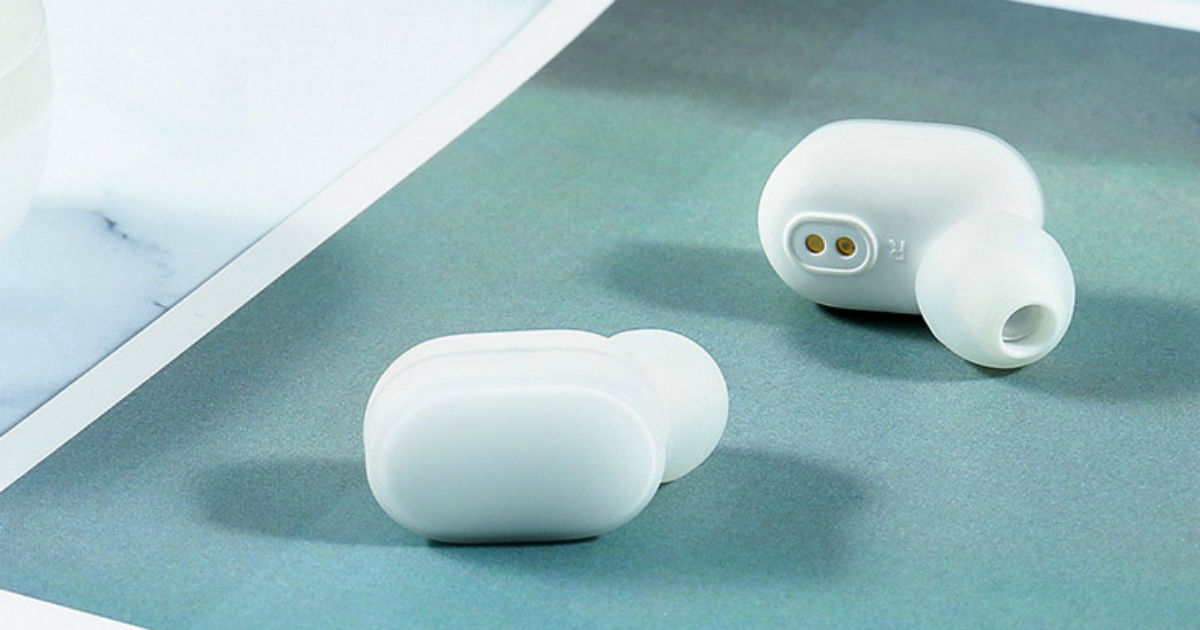
    Xiaomi has been on a roll, launching products that are affordable, yet have great quality. In an event in China, Xiaomi recently launched two new products. A wireless Apple-styled white earbud and a new notebook powered by the intel i3 processor. Xiaomi is known to take their design cues from Apple, previously having launched products that look very similar to iPhones and MacBooks and the earbuds are no different. Even the name of the product AirDots sound eerily similar to AirPods by Apple.

    AirDots

    The AirDots have tappable controls and a compact charging case just like the AirPods from Apple. They costs around 199 yuan which is about $29 and they look quite good too. They are slightly rectangular in shape compared to AirPods and have silicone tips that allow for better sound isolation and a better fit. There are speculations that they might soon be added in the box with Mi phones, just like the wireless chargers that were recently announced as well. The AirDots run on Bluetooth 5.0. They also connect to the last paired device automatically once they are taken out of their case. The standalone battery life is around 4 hours and the battery time with the case is around 12 hours.

    Also Read: Xiaomi Mi Mix 3 With 10 GB RAM & 5G Support Launched

    Xiaomi Notebook

    Xiaomi also launched two new laptops in their Notebook range. A 13-inch and a 15.6-inch screen laptop. One of them costs RMB 3,099 and features a Core i3 processor that has two cores and four threads. Clocked a maximum turbo frequency of 3.9GHz, the laptop has 4GB of RAM and 128GB storage. It also features an SSD drive. It also has a dual fan cooling system to keep the heat down. The other laptop is priced at RMB 3,799 and features a 13.3-inch display with Intel’s 8th generation Core i3 processor. The difference is in the memory as it is paired with 8GB of RAM and 128GB SSD storage. This laptop also has a fingerprint scanner for biometric authentication.

    The laptops will go on sale in China on November 1 but it is unclear if they will be launched in India or not. It is reported that Xiaomi intends to launch a few models of it’s notebooks in India soon but no specific dates have been given yet.


  • 2018 Apple iPhones To Drop Qualcomm Chips for Intel

    2018 Apple iPhones To Drop Qualcomm Chips for Intel

    Apple is about to launch its new line of iPhones for 2018 at its September event. The leaks and rumours about the smartphone suggest there will be a relatively cheaper iPhone along with the usual flagship this year.  Apple iPhones going forward may not use Qualcomm wireless chipsets in favour of Intel modems.

    Also Read: Apple iPhone Front Panels Leaked Images Reveal Thin Bezels

    There is a state of turmoil between Apple and Qualcomm. The chipset manufacturing company wanted to charge Apple a percentage of the company’s revenue for using Qualcomm’s modems. This led to the company suing Qualcomm for a hefty amount. In the US, Qualcomm might have to pay $1 million. Now, according to the Chief Financial Officer of Qualcomm, the new 2018 iPhones will not be using the company’s modems. Instead, the smartphones may launch with an Intel modem. There are still a few months before the 2018 iPhones will launch so this news should not affect the launch whatsoever. However, it is worth noting that iPhones have been using Qualcomm modems for a long time. For Apple to switch over to Intel for its wireless chipset is natural since Qualcomm and Intel are the two of the biggest chipset manufacturing companies.

    How Will This Affect The New Apple iPhones?
    Apple intel
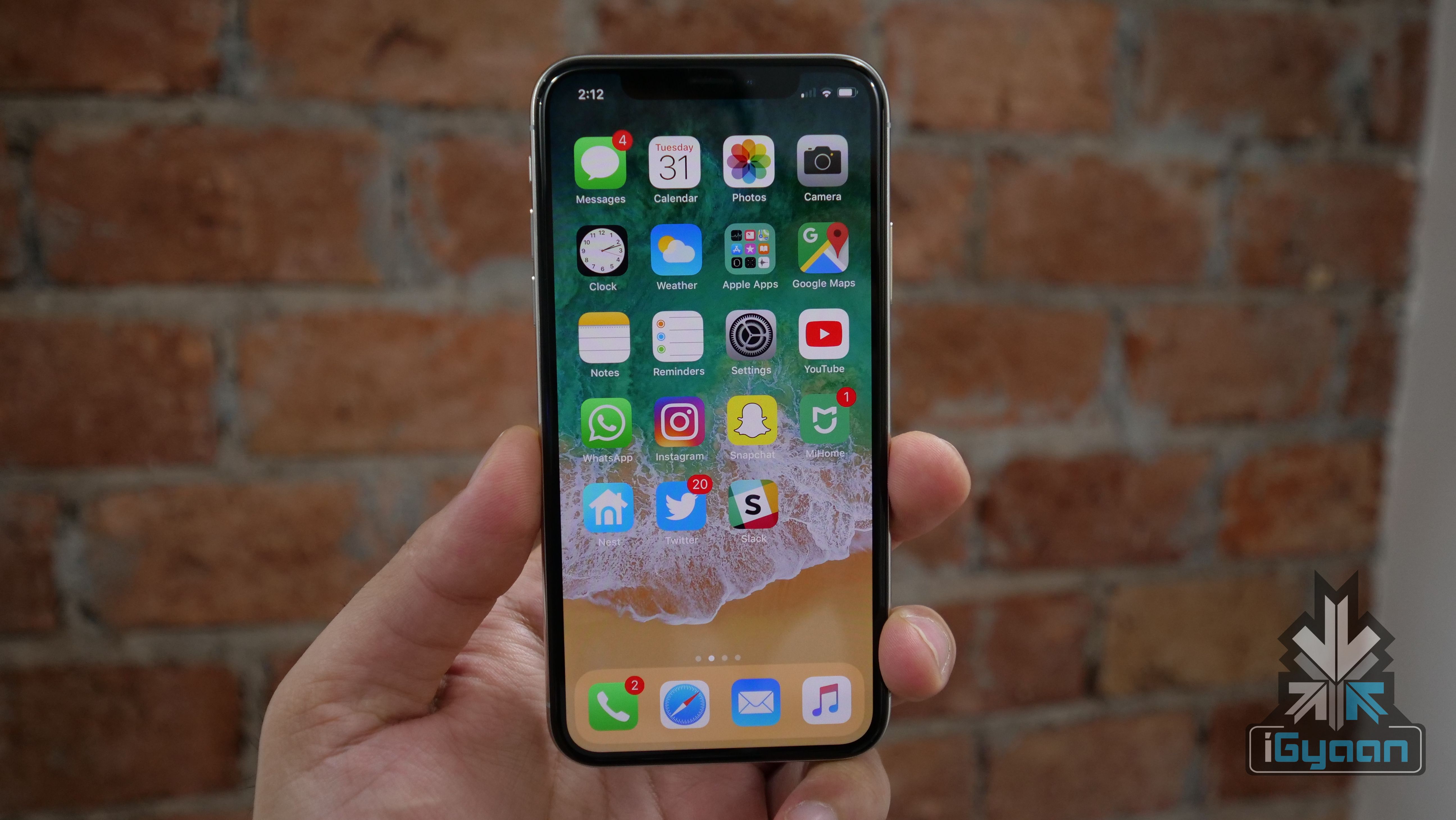
    iPhone X

    As mentioned previously, the decision to go with an Intel modem may not affect the iPhones all that much. However, it will be interesting to see how the Intel LTE modems perform as compared to ones by Qualcomm.

    In 2017 the Apple filed the first lawsuit against Qualcomm and the two have been exchanging lawsuits since. The 2018 iPhones will remain unaffected by the company’s decision to not use Qualcomm chipsets. However, Intel announced that it will not be able to produce 5G ready modems by 2019 so it will be interesting to see what Apple decides to do in 2019.

    Have something to add? Leave a Comment Below!
  • Sennheiser Debuts 3 New Earphones Including 10-Hour Wireless Option

    Sennheiser Debuts 3 New Earphones Including 10-Hour Wireless Option

    Sennheiser has launched three new earphone models at the IFA 2017 in Berlin yesterday.

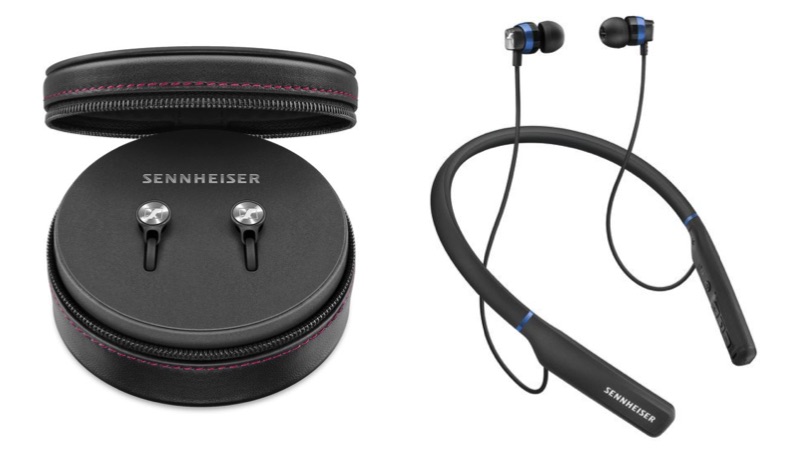
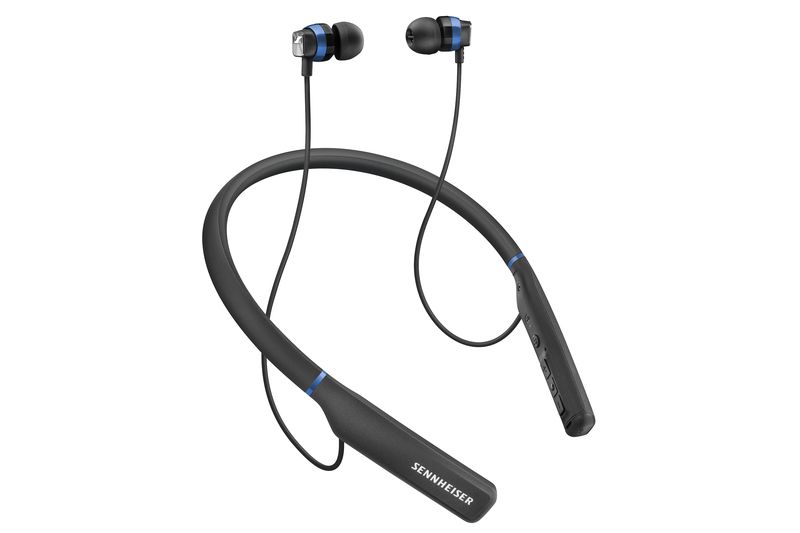
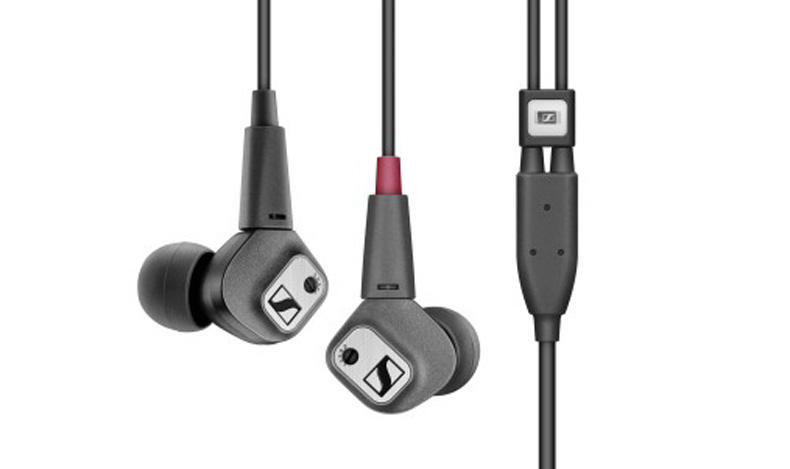
    The trio of new earphones include Sennheiser’s wireless CX 7.00BT, a wired IE 80 S and another wireless model, the HD1 Free.

    HD1 Free

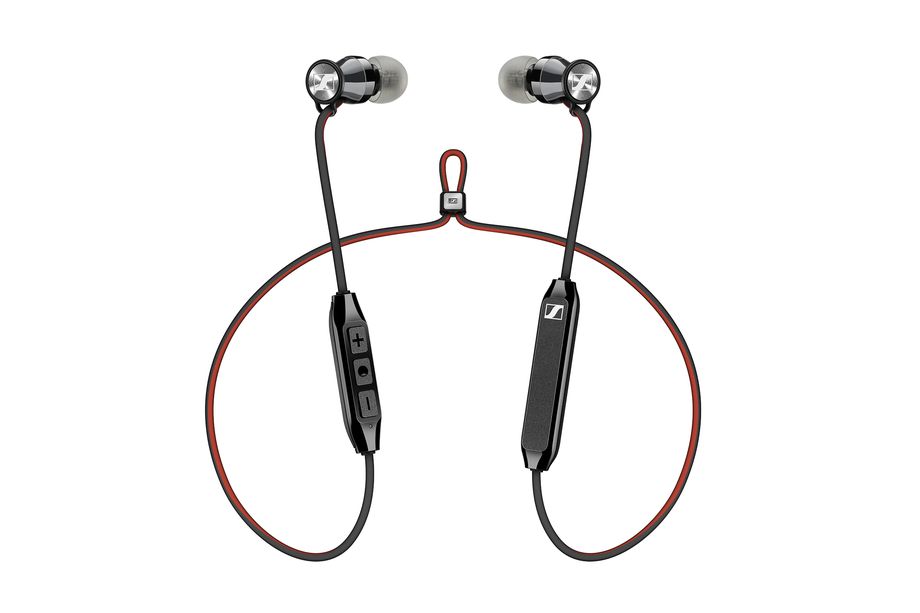
    The one that top’s the list is the new addition to Sennheiser’s HD1 Wireless earphones, the HD1 Free. On the design front, the new HD1 Free are significantly slimmer as compared to Sennheiser’s first HD1 In-Ear Wireless. Apart from the slimmer design, the HD1 Free will feature custom machined steel in-ear sound tunnels, magnetic earpieces, a three button remote and microphone for calling and playing music. The wireless earphones can last 6 hours on a single charge, support Bluetooth 4.2, AptX, and AAC and come with a leather carrying case. Pricing details are yet to be announced but the Sennheiser’s HD1 Free will be available for purchase from October.

     CX 7.00BT

    Featuring a minimal neckband-style design, the CX 7.00BT last 10 hours on a 1.5 hour charge. These in-ear earphones support NFC for one-touch pairing and can be used as both wired or wireless earphones. The CX 7.00BT I includes four sizes of ear adapters and unlike the HD1 Free, the CX 7.00BT support Bluetooth 4.1. The earphone’s multi-connection capability allows simultaneous pairing with up to 2 devices and has 3-way calling support. The CX 7.00BT in-ear wireless earphones are available at Amazon at a price of Rs. 11,990.

    IE 80 S

    An update to the previous IE 80 variant, the newly launched IE 80 offers enhanced fit and customization. The latest model of the IE 80 comes with a “unique” equalizer function, interchangeable cables and ear tip options. An additional smart remote cable with one-button control and an inline microphone for making calls or controlling music is also available. The IE 80 S comes with a carry case for storing the earphones and accessories and will go on sale from September.

  • Samsung Gear IconX Review : Good Wireless Earphones

    Samsung Gear IconX Review : Good Wireless Earphones

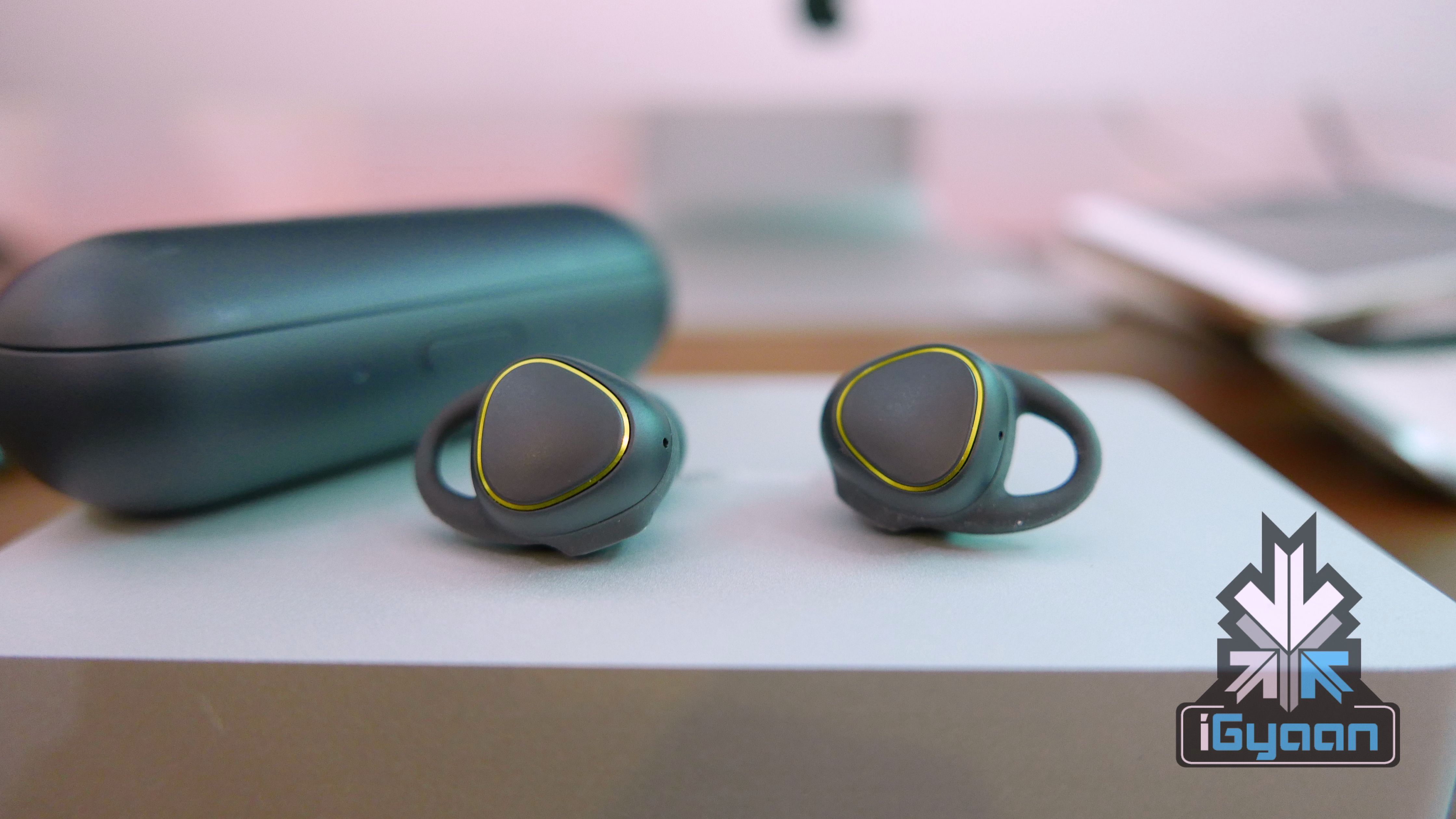
    Samsung Gear IconX is the first wireless set of earphones, offering true cord free experience from a big company. But, are they really worth the big price tag, or should you consider something more affordable.

    [section label=”Design”]

    Design and Build

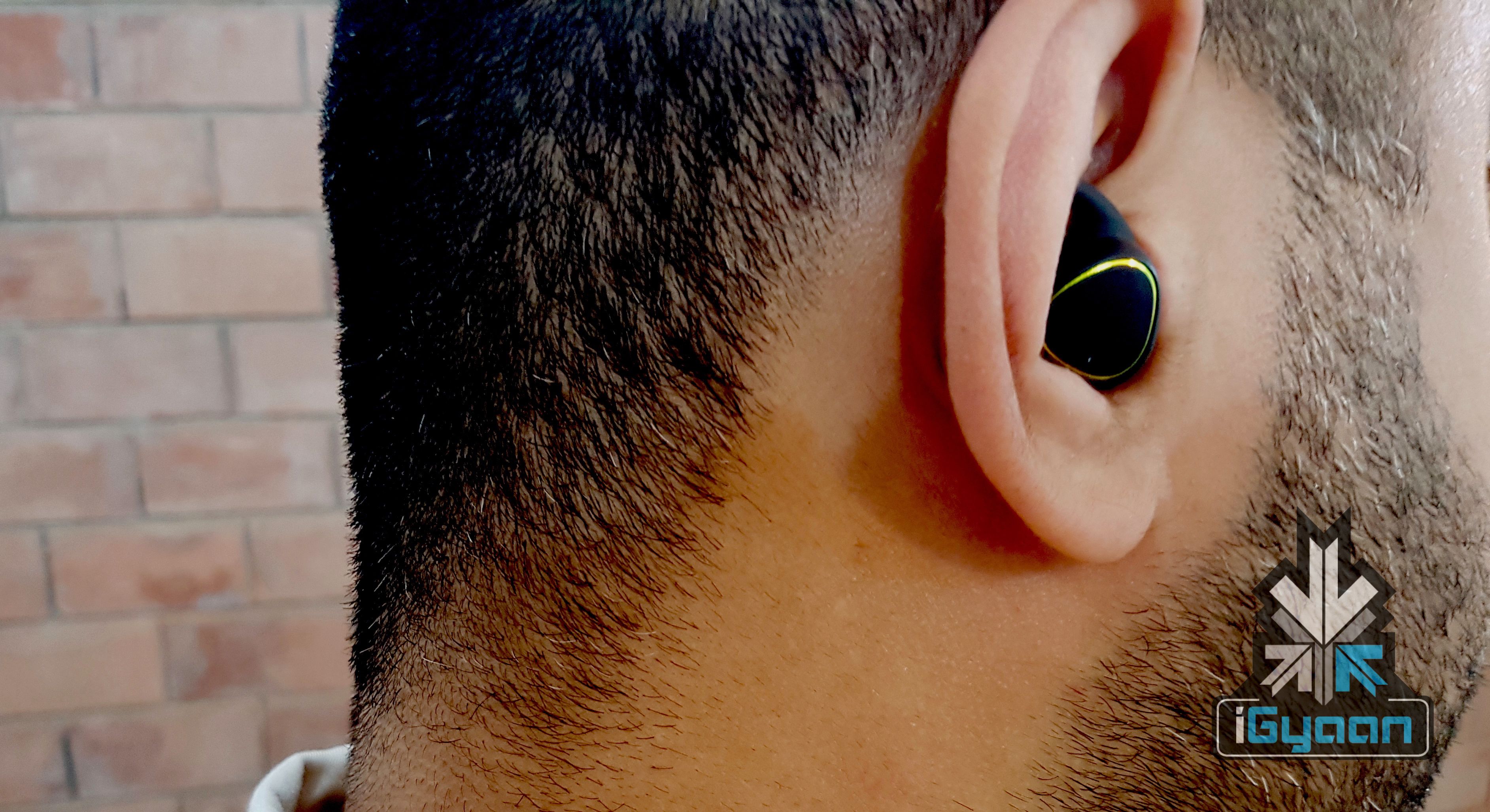
    The Gear IconX is built really well, with a good quality outer casing. The earphones offer up splash and dust resistant P2i Nano coating despite having a fairly wide feature set. They should withstand your sweat incase you decide to use these for your active life or sports.

    The included wing tips and in ear plugs come in a total of 4 different sizes for a perfect fit and are extremely easy to switch.

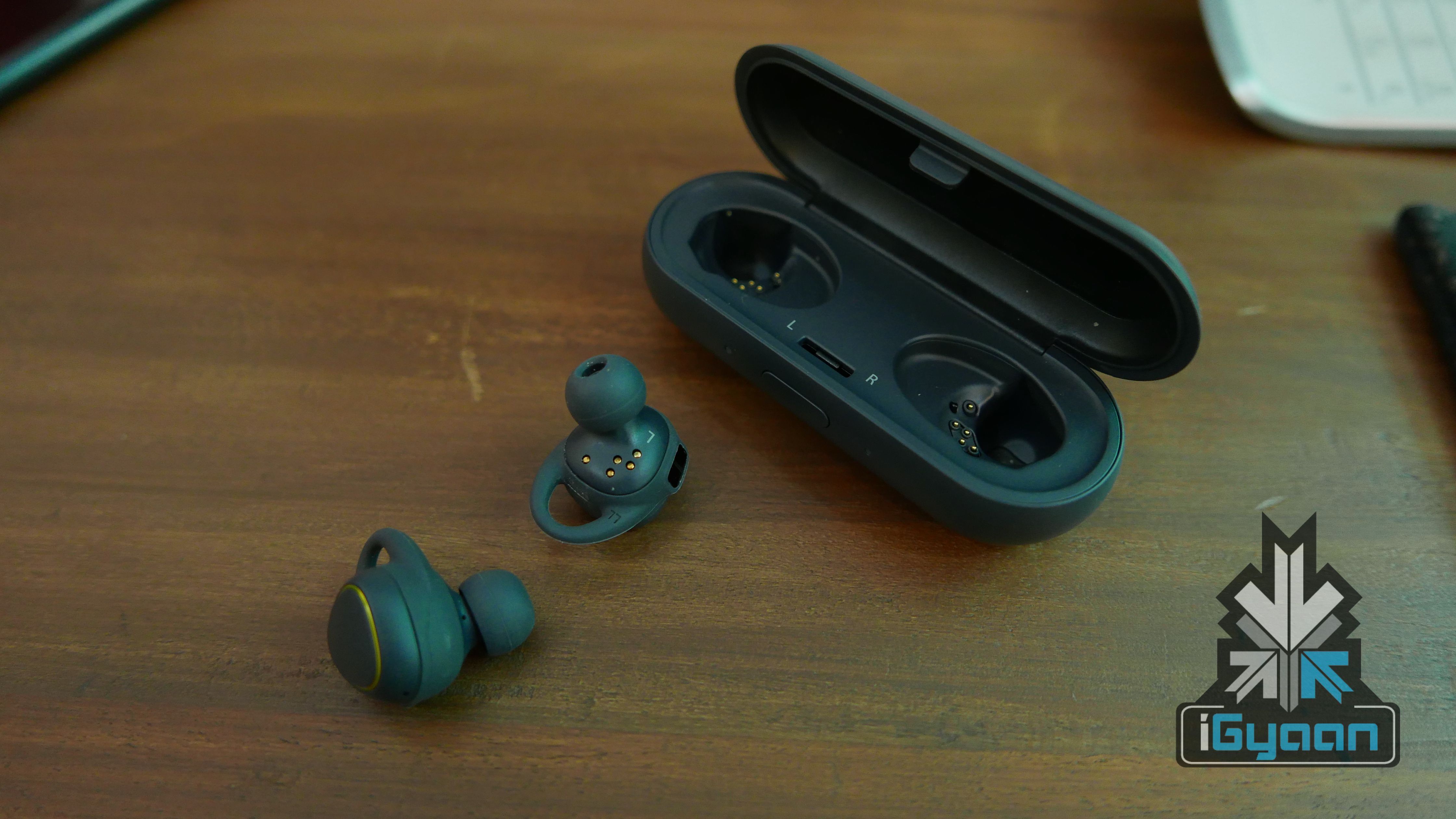
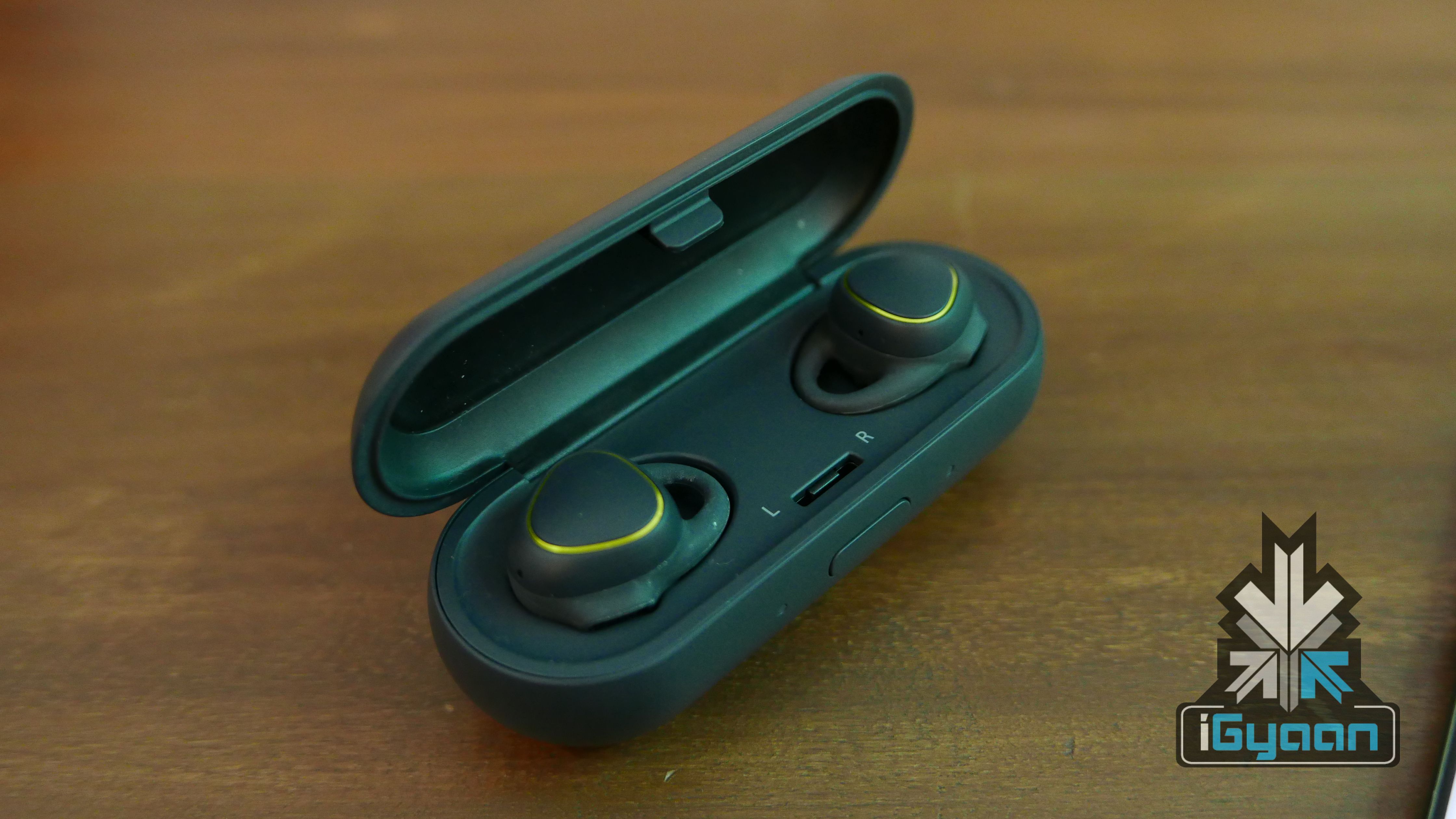
    The carry case also has a rubberized coating on the outside and is built to survive several drops, and it does not pop open incase you do drop it.

    samsung-gear-icon-x-3

    [section label=”Hardware”]

    Hardware

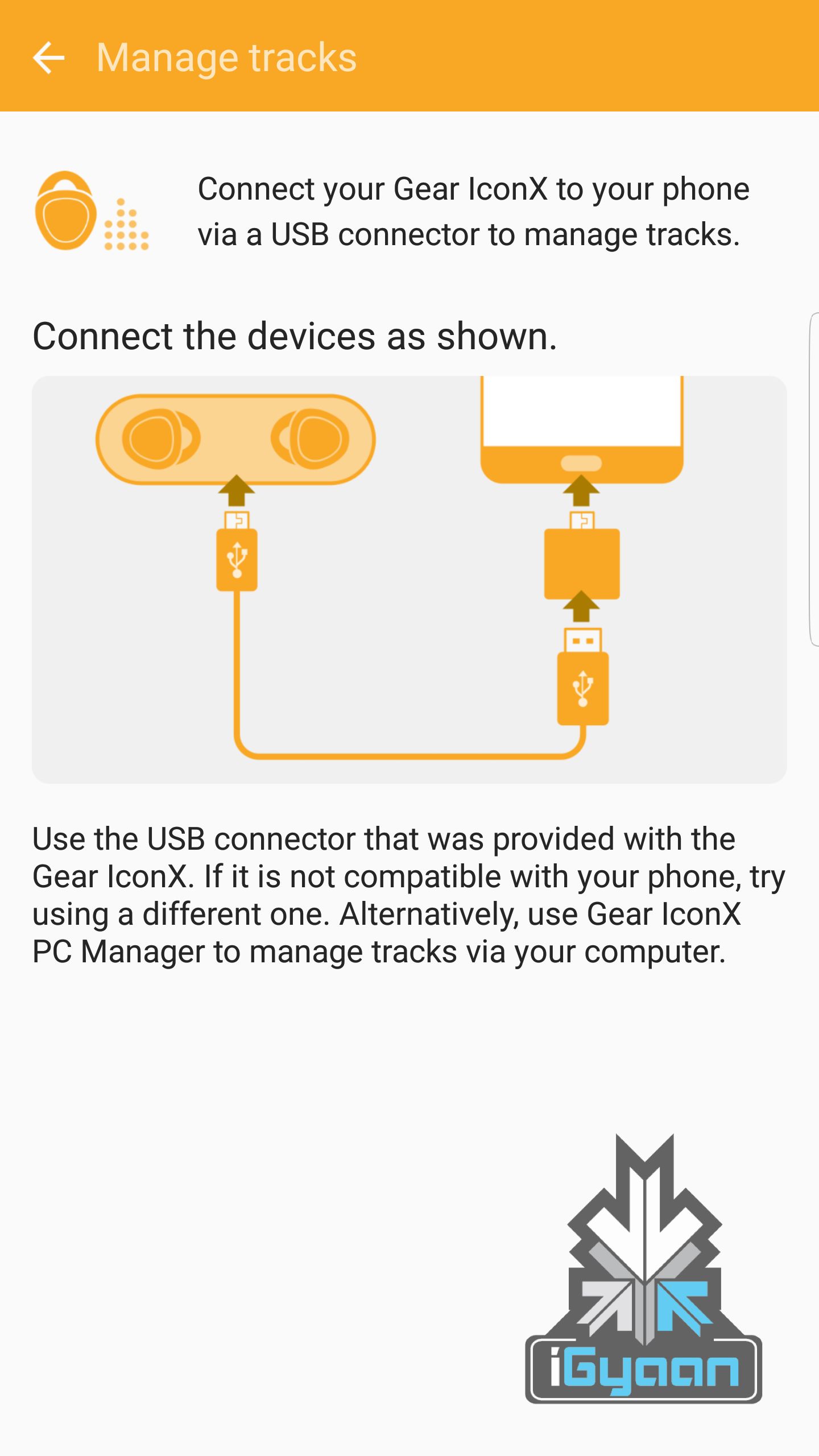
    The Samsung Gear IconX comes with 4GB of inbuilt storage, which can come in handy if you decide to get some music without your phone. Connectivity with your smartphone is via Bluetooth 4.1 (BLE). The Gear IconX also track your fitness via the inbuilt HR sensor and an Accelerometer. The capacitive touch input on both earphones allow for handling and navigating through your music handling calls and listening to the contextual menus.

    The Gear IconX come with 2 microphones per earbud, for noise cancellation and audio for phone calls. The Frequency Range is 20~20 kHz, with a Speaker Sensitivity of 89.5 dB ± 3 dB / 1mW and a Speaker Impedance: 16 ohm.

    Each earbud has a inbuilt 47 mAh while the outer carrying case has a 315 mAh.

    samsung-gear-icon-x-7

    [section label=”Audio Performance”]

    Performance and Audio

    When you setup your Gear IconX with your phone, the audio is usually set to 50% which is optimised to get you a good battery life.

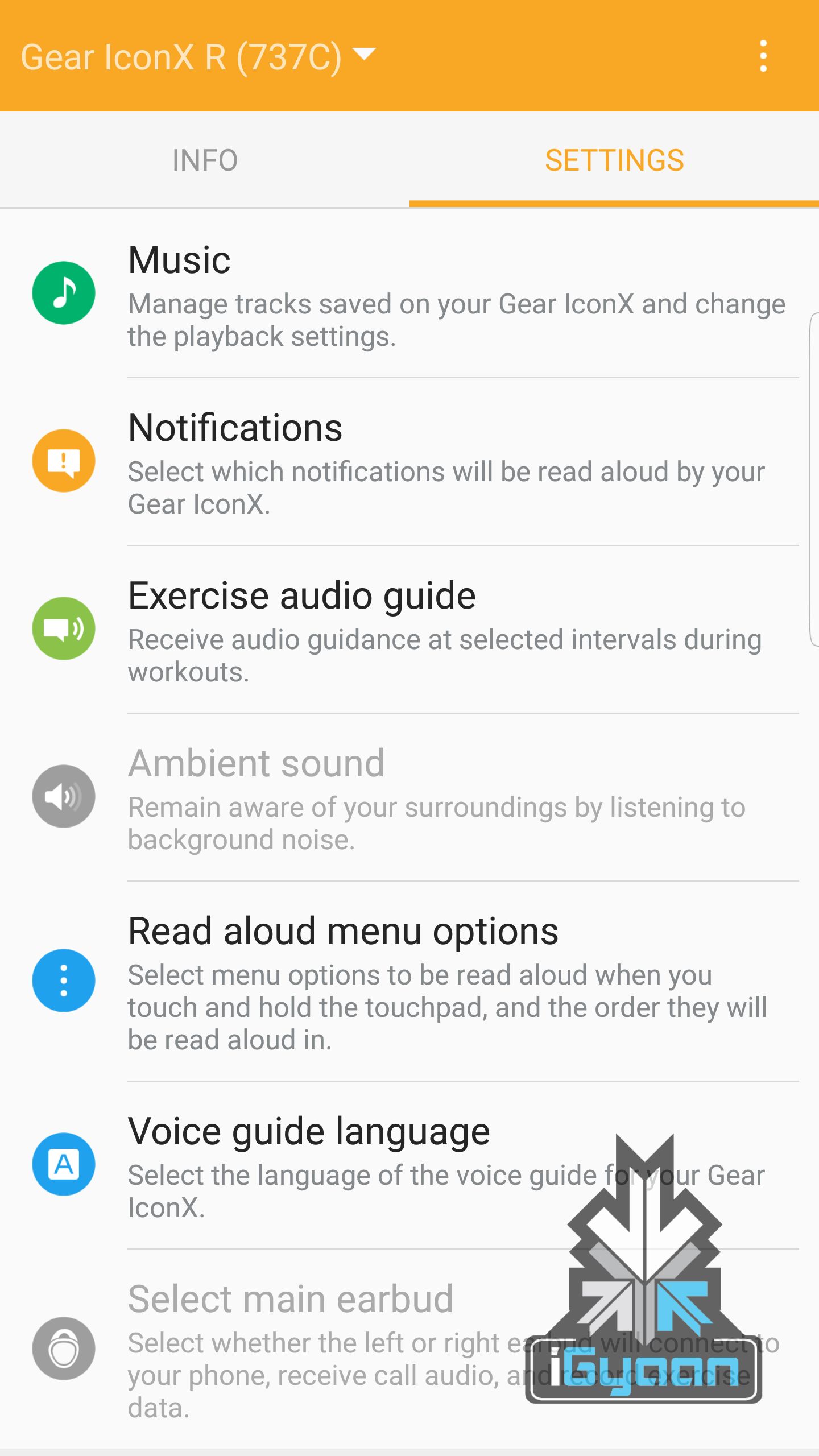
    Audio performance is excellent, while music volumes can be extremely high. Low range and Mids are handled extremely well and audio profiles can be customised using the Gear app on your Android phone.

    You can also use a single earbud as a regular bluetooth earpiece incase you like to keep it old school and answer your calls like that.

    If you go for your run or go about your fitness routine without your phone, the earphones will still track your health info and heartbeat and then sync up with your phone later.

    As wireless earphones they have excellent range and sound and thanks to the snug fit the outside noise is easily cut. The ability to long press and listen to ambient sound means you don’t need to constantly pull the earphones out of your ear.

    [section label=”Battery Life”]

    Battery Life

    The biggest downfall of the Gear IconX has to be the battery life, if you increase the volume from the default while connected to your phone, you will need to charge the IconX every 60-75 minutes. Which if you are used to listening to music for long periods is a definite negative.

    The carry case will charge both your earbuds a total of three extra times. However, if you leave your earphones in the case they will be charged constantly basically draining the battery of the earphones and the case as well. Which means leaving your earphones overnight will kill them, making them impossible to travel with.

    samsung-gear-icon-x-2

    [section label=”Conclusion”]

    Conclusion

    The Samsung Gear IconX is the best direction towards a truly wireless music experience, and seems like a better setup than what is expected from the Apple AirPods. However with a 5 hour battery the AirPods have the definite advantage. The Gear IconX will work with iPhones and Windows Phones too if you have those, however, you will get basic bluetooth connectivity and not deep controls and customizations which can be had on Android phones via the Gear App.

    The battery life however is a step backwards, and it seems that Samsung rushed into these too early without figuring out real usage scenarios. The poor batteries make it difficult to use these daily, or ever! The battery life is also unwarranted considering the heavy price tag on these.

    This is the right approach, however, it’s pre-mature and the battery life is unacceptable, sound quality and volumes are great. The earphones are extremely light and fit well in your ear. The fitness features are also a great add-on.


  • Apple AirPods Are Wireless EarPods with 5 Hours of Wireless Audio

    Apple AirPods Are Wireless EarPods with 5 Hours of Wireless Audio

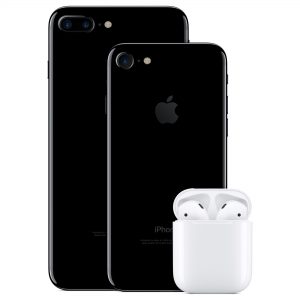
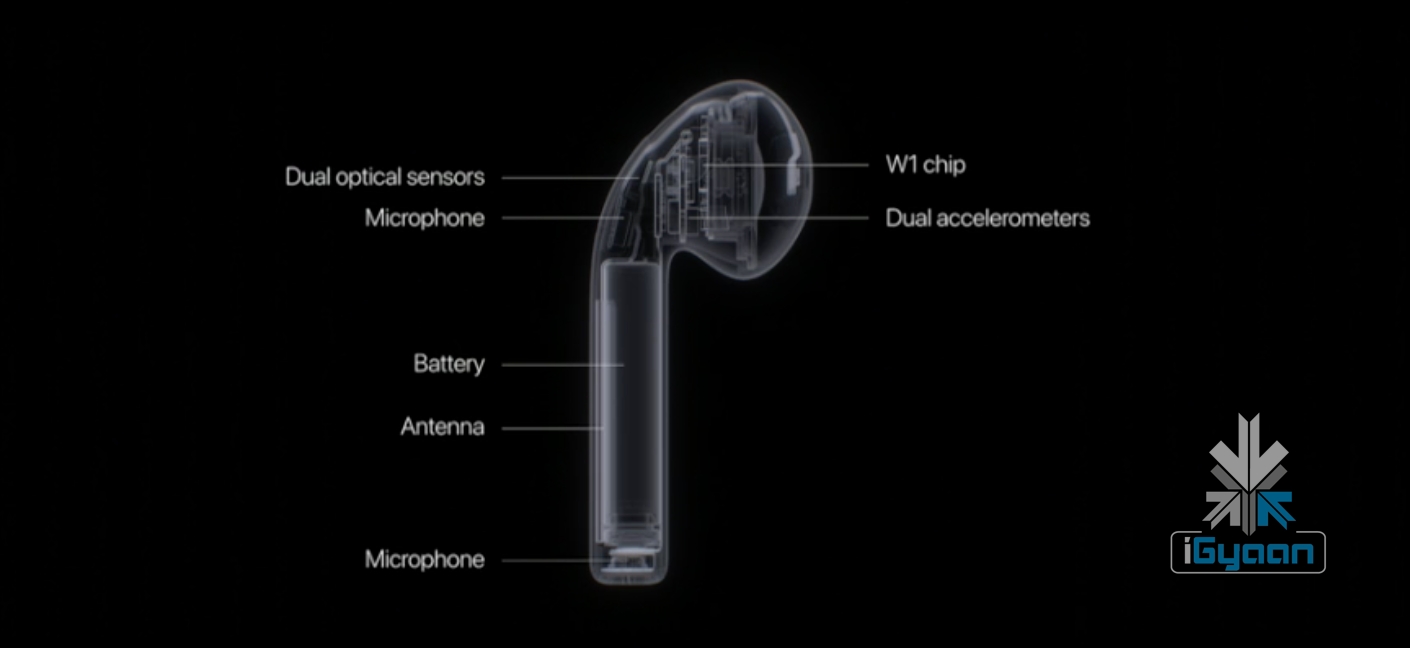
    With the launch of the iPhone 7 and iPhone 7 Plus,Apple has also launched the new Apple Airpods. A $149 accessory that will allow users to connect to the new iPhone 7 and iPhone 7 plus using the new Apple W1 chip (wireless connection chip).

    apple-iphone-7-24

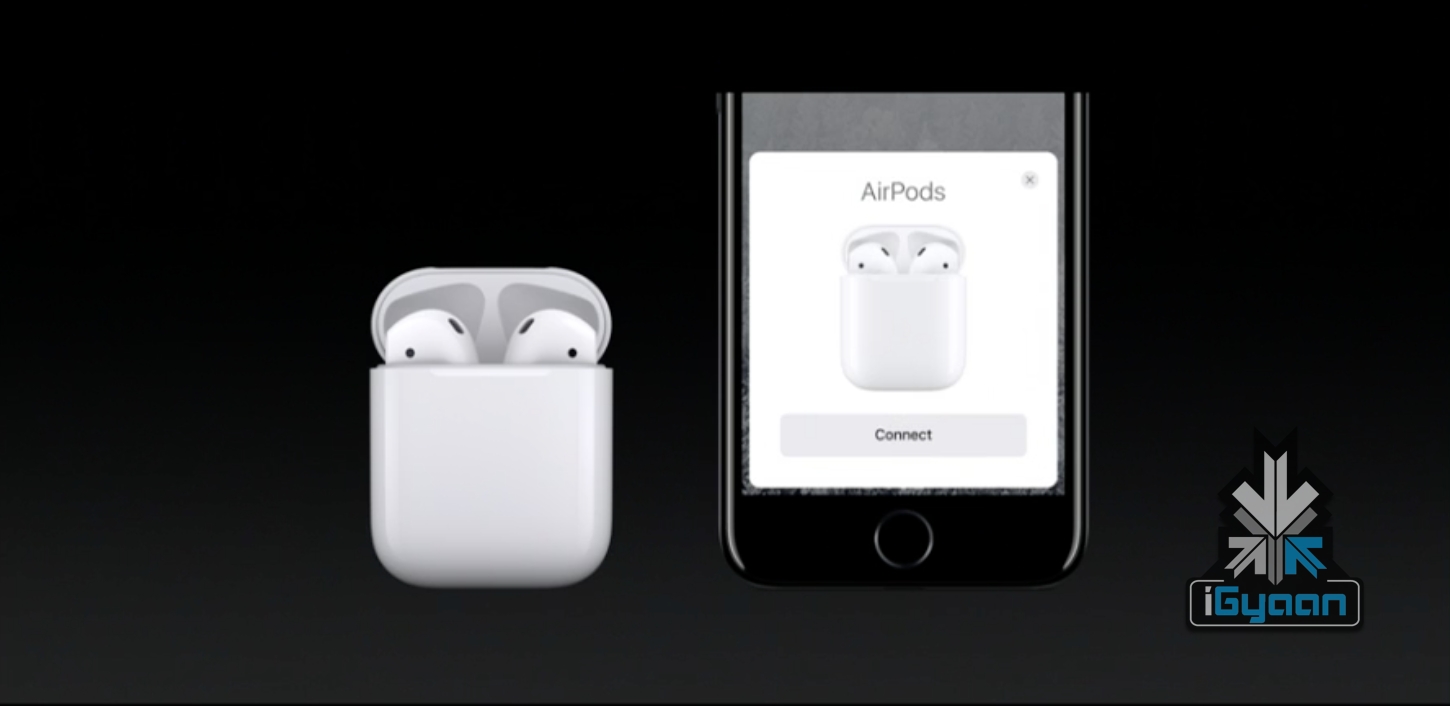
    Paring requires you to simply bring the AirPods close to the iPhone and select connect. The AirPods will then be available across all iCloud account devices automatically.


    apple-airpods-battery

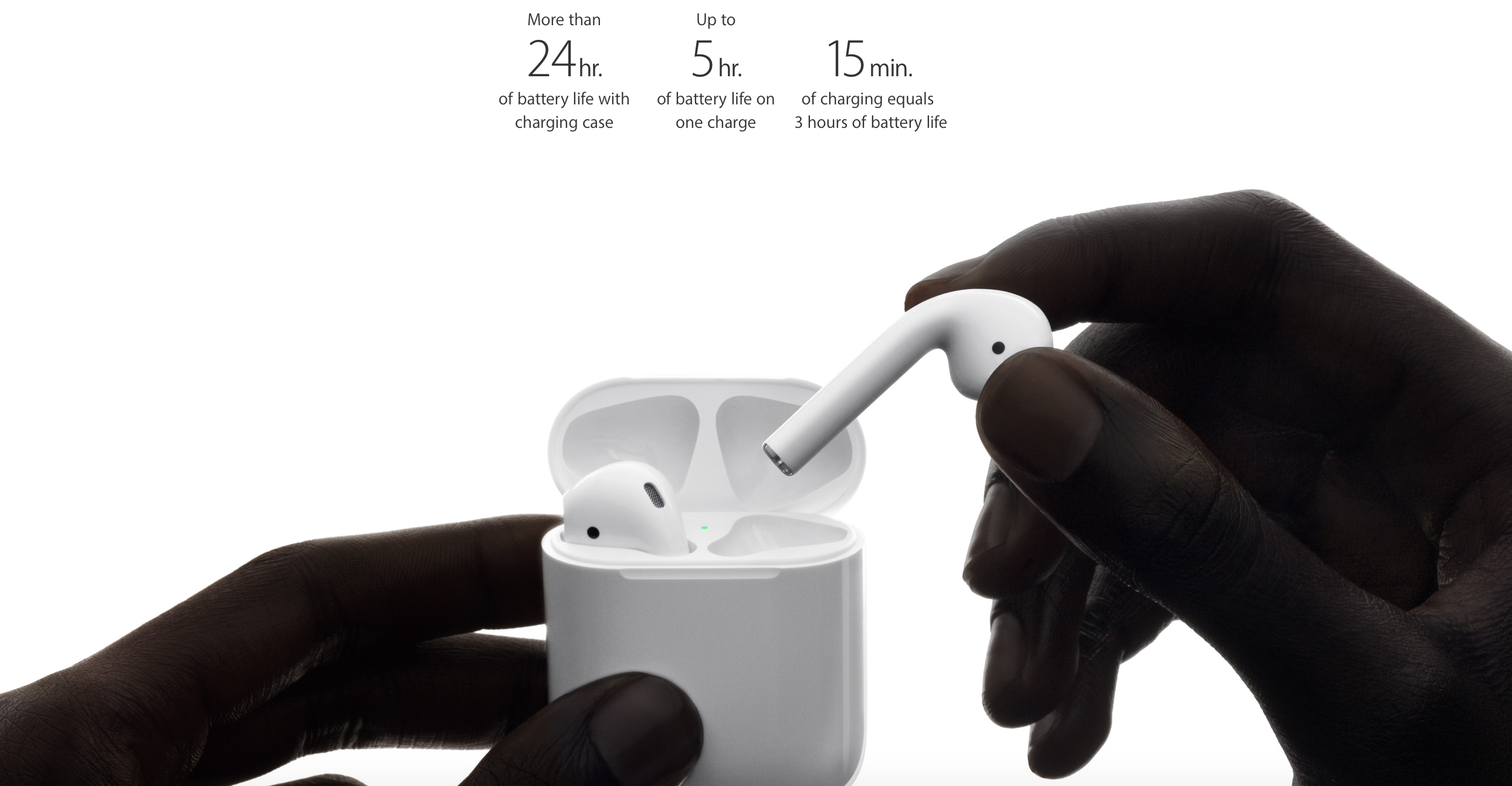
    The Airpods offer 5 hours of continuos play and the AirPod case provides acts as an addition 24 Hours of backup battery pack.


    The airpots much like the Samsung Gear IconX are truly wireless however have a traditional earphone design, more bluetooth headset like. both sides include a wireless microphone and touch controls.

    apple-iphone-7-33

    The Airpods will be available late October for US $ 149 in the US market. Apple will launch the AirPods in India in November for Rs. 13499 .


  • Apple Developing Tech That Allows Charging From a Distance

    Apple Developing Tech That Allows Charging From a Distance

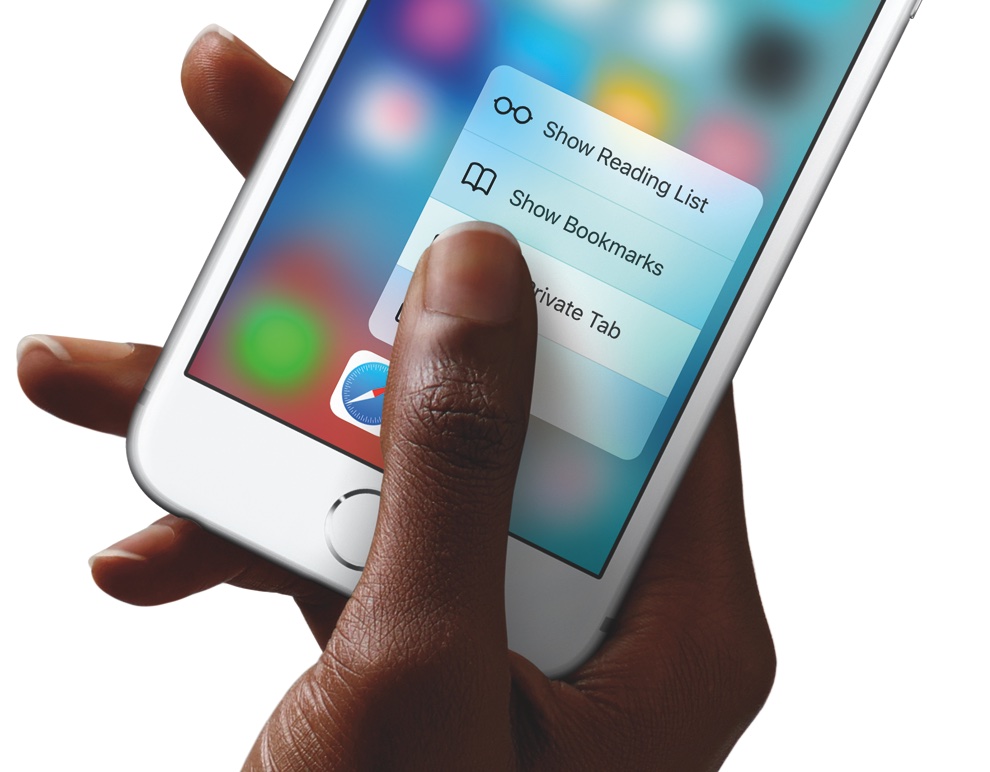
    Apple is working on wireless charging which would allow devices to be charged even at a distance from the charging port. The Cupertino-based company is reportedly collaborating with American and Asian partners to develop this tech.iPhone 6s 3D Touch

    Currently, the Apple Watch is capable of getting charged even from a few millimetres away from the source. But that isn’t really a groundbreaking development. Also, increased distance between the device and the charging source means a fall in efficiency. Apple is currently focusing on overcoming these problems and making wireless charging smoother. We can expect to see this kind of technology in 2017.

    If this development is adopted in future Apple devices, the user could charge their phone while walking around the room. Charging your phone could be like using any other wireless tech like Wi-Fi. Apple made a patent application in 2010 which makes an iMac a source of wireless charging for Apple devices at a distance of 1 metre using a technique called near-field magnetic resonance.

    Though wireless charging still exists, it’s only in its nascency. There is a long way to go before it can be employed in a useful and productive way. Let’s see if Apple becomes a pioneer in incorporating this kind of charging in its devices.

    Source

  • SanDisk Launches Connect Wireless Stick in India

    SanDisk Launches Connect Wireless Stick in India

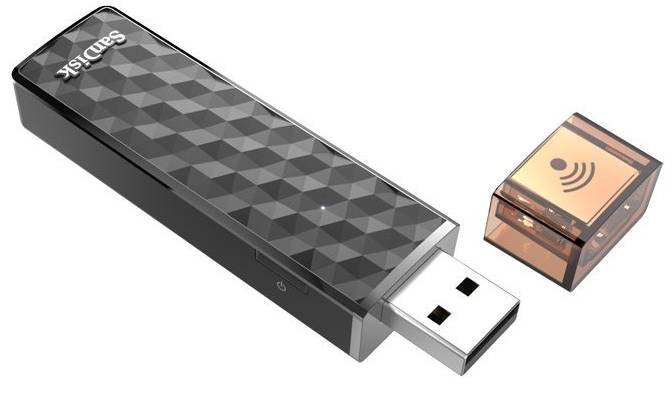
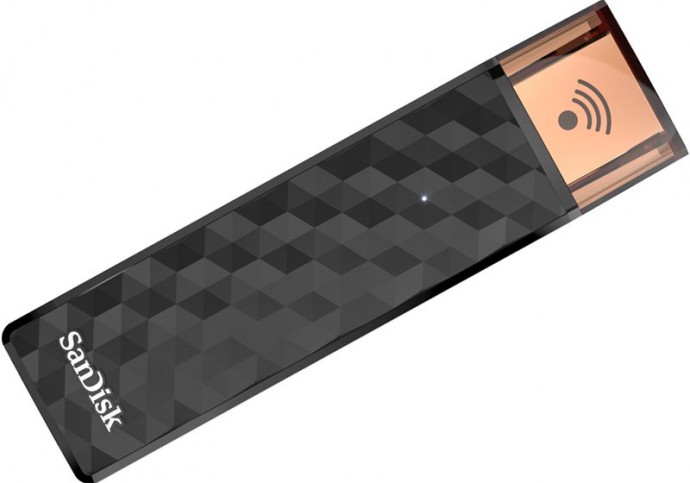
    SanDisk has come out with a way that allows you to store data wirelessly. The company launched the Connect Wireless Stick in India that allows wireless transfer of files and media to and from your laptops, PCs, and mobile devices with the help of its built in Wi-Fi hotspot. The device is especially useful since most Tablets these days come without a MicroSD storage. The Connect Wirless Stick can allow multiple devices to transfer and store data, simultaneously.The device will also function as a standard USB flash drive as well.

    1e8-OBLzyPWH.878×0.Z-Z96KYq


    It terms of design, the device looks both stylish and professional with a hexagonal pattern on the body and a LED in the front to indicate whether the device is on, if the battery is low, if it is charging, or if data is being transferred. The device also comes with an auto back-up of images and videos from your camera roll. The Stick will surely speed up the way data is transferred by not having to connect it manually to a device everytime. However, the device only supports USB 2.0 and not 3.0 which limits the transfer speed to a maximum of 60mbps.

    SanDisk says that the Connect Wireless Stick can stream 4.5 hours of video on a single charge, but can lower the figure when connected to multiple tablets and phones.

    Dinesh Bahal, Vice President, Product Marketing, SanDisk had said at the global launch in July, “We live in an era where we are truly living a mobile lifestyle. We use our devices to capture life’s moments, and work in a way that was never before possible – all of which has created the need for a new generation of mobile storage,”

    The device will be available on Flipkart from the 18th of September and will come in 16GB, 32GB, 64GB, and 128GB for Rs. 2,790, Rs. 3,790, Rs. 5,490, and Rs. 9,490 respectively.

  • Wireless Charging: Everything You Need to Know

    Wireless Charging: Everything You Need to Know

    This year, at the Mobile World Congress held in Barcelona, we saw that Wirless Charging was one of the most talked about subjects. Many big companies such as Samsung, Microsoft and Motorola have been investing heavily in this technology.

    So, what is Wireless Charging? As the name suggests, it is the method of charging a device sans a physical wire. This concept is not new. Nikolas Tesla, whose work in the field of electricity and electromagnetism has defined our modern lifestyle, spectacularly demonstrated the possibility of wireless power transfer in 1891, as visualized by the principle of electromagnetism by Michael Faraday 60 years before. The experiment was quite successful, but long distance wireless charging is still not a practical idea. However, Tesla’s research on short distance wireless power transfer became a reality.

    nikola-tesla-magnifying-transmitter

    It took nearly a century for the technology to find its way in the mainstream industry, but now, this technology has finally emerged into the consumer electronics market.

    In 2008, the newly formed Wireless Power Consortium began outlining plans to design the world without wires, of devices that could juice up upon being dropped on charging pads. But, the journey ahead to seek and work out such technology was difficult. Hence, the work began on achieving this.

    How does it work?

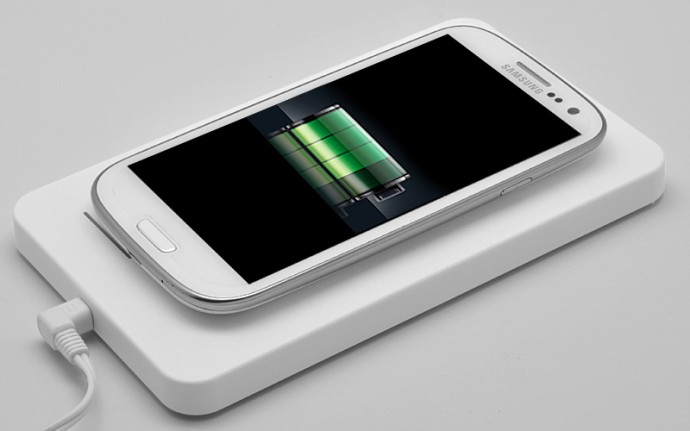
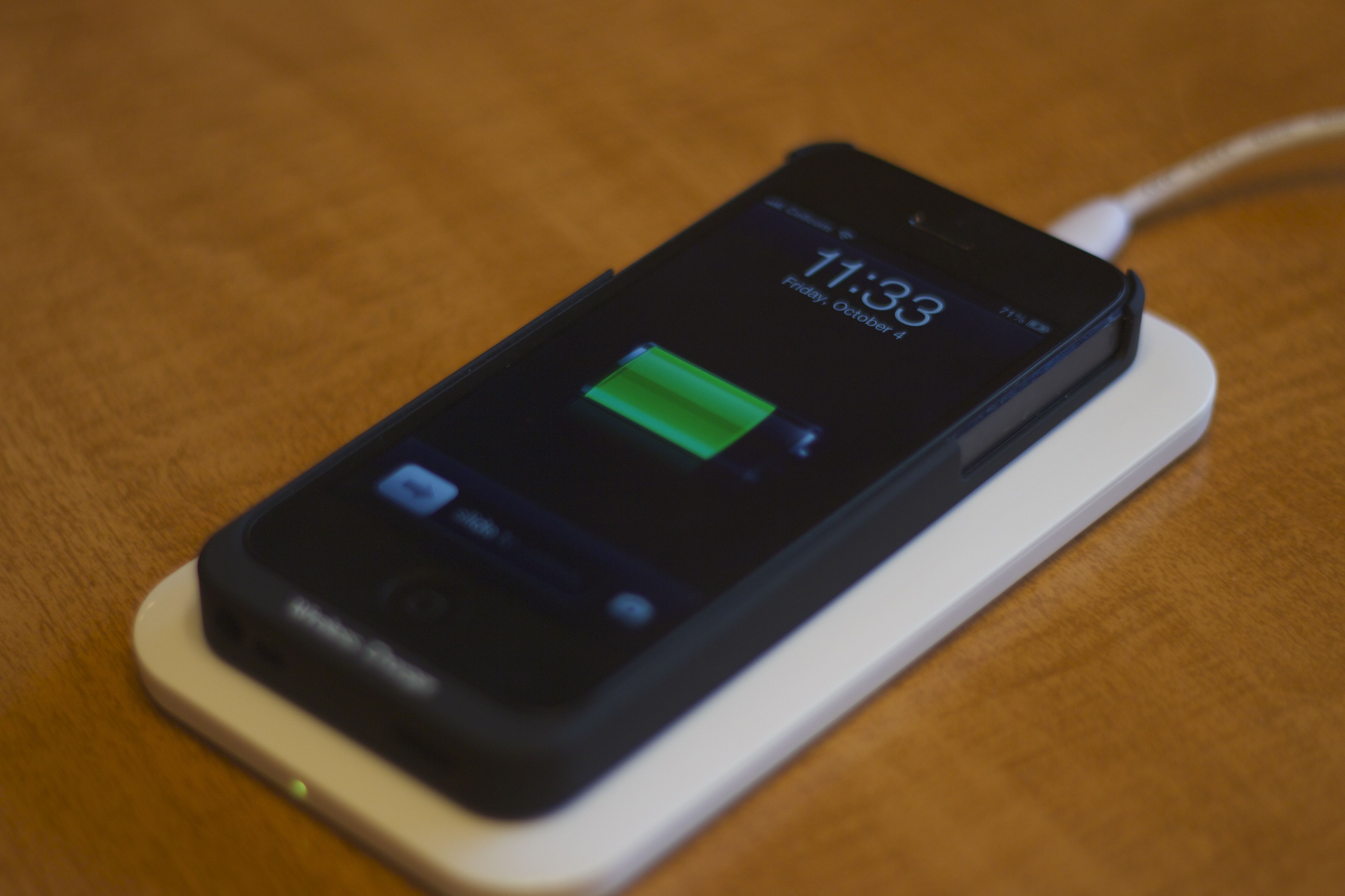
    Wireless charging, also known as ‘Inductive Charging’ is based on the principle of magnetic resonance or Inductive Power Transfer- the process where electricity is transferred between two objects through coils. This process uses an induction coil to create an alternating electromagnetic field from within a charging base station. The second induction coil inside the portable device (namely, smartphones) receives the power from the electromagnetic field and converts it into electricity to charge the battery. The two induction coils are in close range to form an electrical transformer.

    This interface was developed by the Wireless Power Consortium for inductive electrical power transfer over 4cm. You just have to place the device on to the power transmission pad, and it charges using resonant inductive coupling. Just plug in the charging dock and place your device on the charging pad. Then, watch your device juice up. It’s that simple. For now, Qi, pronounced as ‘Chee’ is leading in the wireless charging technology.
    Asus, HTC, LG, Motorola, Samsung and Huawei are among the few mobile device manufacturers that are working towards the required standard of Qi.

    img_7553

    To this end, the industry has set up three groups that are working to standardise wireless charging technologies: the Wireless Power Consortium (WPC) and its Qi standard, the Power Matters Alliance (PMA) and the Alliance for Wireless Power (A4WP).

    Advantages

    • No requirement of a power cord: The first and foremost reason wireless charging is being worked upon is to eliminate the use of wires and cables. Elimination of cables also means less e-wastage.
    • Portability: It is small. Hence, you can carry it anywhere along with you. It can be used in your car, house or garden.
    • Ease of access: Wireless charging points are slowly being accepted in different outlets and food joints. For example, a type of wireless charger is being used in some McDonald’s outlets in UK. This device allows multiple devices to charge at the same time.
    • Environmentally friendly: The growing use of wireless charging technologies reduces CO2 emissions by hundreds of tons each year by eliminating disposable batteries and cords. Your use of a wireless charging device will be contributing to a more sustainable environment by helping to reduce world waste.
    • Safety: Wireless charging eliminates sparks and debris related to wired contacts.

    For now, there are two very important factors that may play foul against wireless power charging:

    • A risk of radio interference: Emissions from the wireless charger may cause radios and other devices using energy in the same frequency range to malfunction. This is due to the radiation and the signals which cut each other if they are in the same frequency.
    • Energy consumption: Wireless chargers will always waste more power than their wired versions, and the more flexible adaptive resonance devices will be most at risk of that.

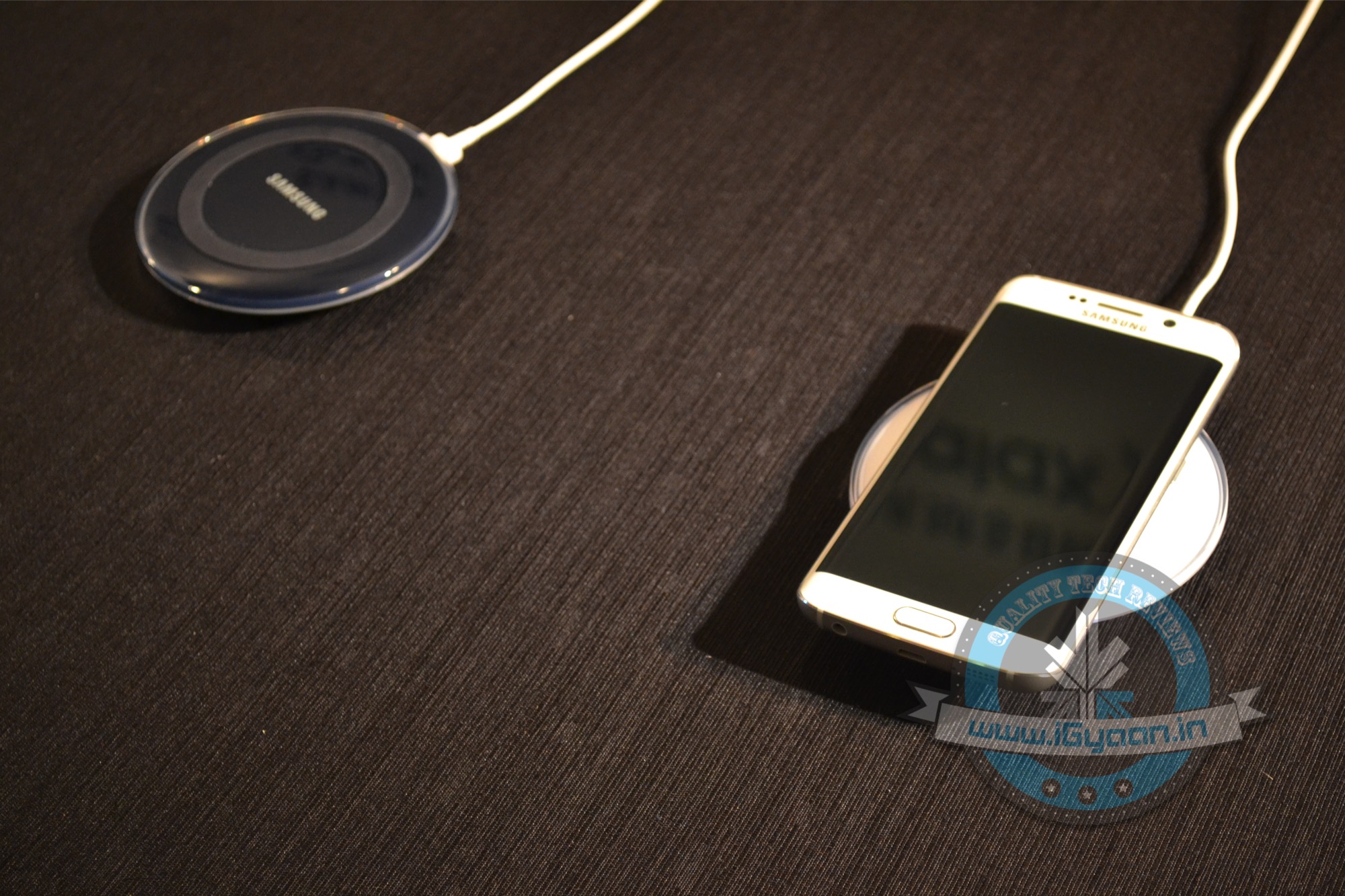
    Samsung Galaxy S6 Edge Wireless charging

    Standardisation would allow the ecosystem for wireless charging to develop and evolve fast. But, it is hard to say about the future of this technology. This technology has just started out and is still in its developing process. But, if it works out successfully on a large scale, people would be able to charge all of their devices wirelessly in restaurants, airports, public spaces, cars and living spaces, freeing them from the burden of carrying their power cords.

  • uBeam to Bring Revolutionary Wireless Charging Technology to Market

    uBeam to Bring Revolutionary Wireless Charging Technology to Market

    Los Angeles-based startup uBeam is developing a wireless charging technology that will allow people to charge their devices without cords and without having to be right next to the charging station.

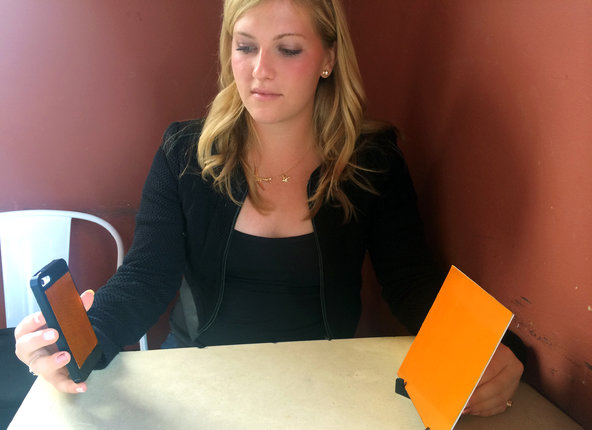
    The uBeam system developed by Meredith Perry uses ultrasound and converts electricity into sounds, that are then transmitted by ultrasound to the required devices, charging them in the process.

    bits-ubeam-tmagArticle

    Originally Perry studied astrobiology at the University of Pennsylvania with the goal of finding life on other planets. However during this process she accidentally stumbled upon the wireless charger technology to charge portable electronics using the ultrasound system. Perry explained :

    “This is the only wireless power system that allows you to be on your phone and moving around a room freely while your device is charging. It allows for a Wi-Fi-like experience of charging; with everything else you have to be in close range of a transmitter. If wireless power is everywhere, then the size of your battery can shrink because it’s always charging. You’ll never need a cord again, and you won’t need international charging adapters.”

    Ms. Perry’s company, uBeam, announced on Wednesday that it took an early prototype concept of this technology, first developed for Ms. Perry’s college innovation competition, and turned it into a fully functional prototype that the company now plans to build for consumers.

    Screen Shot 2014-08-09 at 10.41.56 am

    The company’s technology converts electricity to ultrasound, which is then picked up by a receiver in the device, where the ultrasound is converted back into energy. The transmitters can fill a room with ultrasound, charging devices that are equipped with receivers (much as Wi-Fi can provide connectivity to an entire room). Larger transmitters are being developed for stadiums and other large spaces. uBeam’s charging technology is expected to enter the market within the next two years.

    Check out their video here:

  • Report : Internet Trends report finds online growth driven by China and India

    Report : Internet Trends report finds online growth driven by China and India

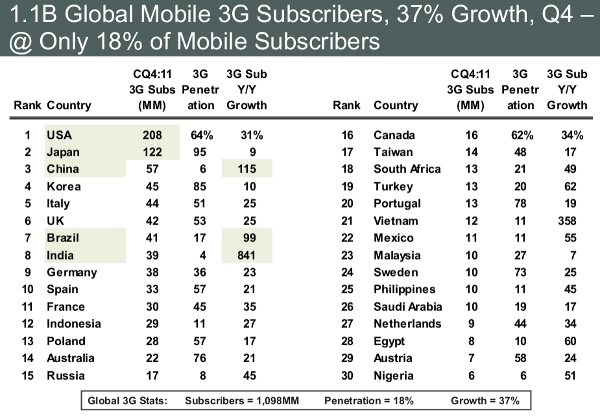
    India, China and Vietnam have all seen triple digit percentage growths in 3G penetration since last year, according to the report by venture capital firm KPCB. Also out of the 663 million online users added over the last three years major chunk comes from India and China. According to the report boon in connectivity is also being pushed by the broader availability of 3G data connections. However , the lack of properly set infrastructure leads to incorrect number swapping. You can read the full report below.

  • New Technology by Nokia Siemens could end network drop problems (PR)

    New Technology by Nokia Siemens could end network drop problems (PR)

    Nokia and Siemens  HSPA+ Multiflow may offer some relief for those pesky tower to tower transitions during transit. delivering double the data speed and up to 50 percent faster response compared to existing HSPA+ networks, says Nokia Siemens.

    Multiflow allows compatible devices on the edge of a cell to connect to two sites simultaneously, letting your device send and receive data between two base stations at once. The technology need not be changed, infact Multiflow will be available as a software update for Single RAN systems, as soon as Nokia Siemens pushes it in the second half of 2013

    [toggle title_open=”Press Release” title_closed=”Press Release” hide=”yes” border=”yes” style=”default” excerpt_length=”0″ read_more_text=”Read More” read_less_text=”Read Less” include_excerpt_html=”no”]


    Mobile World Congress,
    Barcelona, Spain – February 20, 2012


    Presents first ever demo of HSPA+ Multiflow on commercial infrastructure equipment, delivering up to double the cell edge data speed

    Operators will be able to offer enhanced mobile broadband with a new feature for HSPA+ networks from Nokia Siemens Networks and Qualcomm*. Known as HSPA+ Multiflow, it allows devices located close to the edge of a mobile base station’s cell to connect with a second base station serving a neighboring cell. The ‘Multiflow’ name refers to the two different paths data can then take to reach a device. The feature makes far more efficient use of network resources, delivering up to double the data speed and up to 50% faster response compared to existing HSPA+ networks.


    A live demonstration** at Mobile World Congress 2012 of the feature will be based on Nokia Siemens Networks’ commercial Single RAN offering and Qualcomm’s prototype USB dongles.

    “With 100 million smart devices being added every month, we see a consequent increase in ‘smart’ applications that make use of their advanced capabilities. Not only is network traffic rising dramatically, much of it is also unpredictable in nature, and this can impact user experience,” said Keith Sutton, head of the WCDMA business line for Nokia Siemens Networks. “This is where HSPA+ Multiflow helps operators – it reduces imbalances that typically occur in network resource usage, and increases HSPA+ speed and capacity.”

    HSPA+ Multiflow enables simultaneous transmission of two data streams from base stations in two adjacent cells to a single user device instead of one data stream from one base station as is the case with HSPA+*** today. Overall, this can up to double throughput (data speeds) for users at cell edge. Due to Nokia Siemens Networks’ highly scalable Single RAN equipment, operators can protect their earlier network investments, by evolving their existing HSPA networks to the new technology with a simple software upgrade.

    “We are working with Nokia Siemens Networks to drive the evolution and deployment of technologies like HSPA+,” said Serge Willenegger, vice president of product management at Qualcomm. “This demonstration confirms that HSPA+ Multiflow will enable us to further enhance the HSPA+ mobile broadband user experience, and is thus a valuable contribution toward enhancing the HSPA+ value proposition and further expanding global mobile broadband coverage.”

    The HSPA+ Multiflow feature is expected to be 3GPP standardized**** by mid 2012, and will be available commercially from Nokia Siemens Networks by second half of 2013.

    To share your thoughts on the topic, join the discussion on Twitter using #MWC12, #HSPA+ and #mobilebroadband.

    About Nokia Siemens Networks

    Nokia Siemens Networks is the world’s specialist in mobile broadband. From the first ever call on GSM, to the first call on LTE, we operate at the forefront of each generation of mobile technology. Our global experts invent the new capabilities our customers need in their networks. We provide the world’s most efficient mobile networks, the intelligence to maximize the value of those networks, and the services to make it all work seamlessly.

    With headquarters in Espoo, Finland, we operate in over 150 countries and had revenues of over 14 billion euros in 2011. http://www.nokiasiemensnetworks.com


    [/toggle]  

  • Launched Panasonic Lumix FX90, Built in Wifi and Android/ iOS app Compatible (PR)

    Launched Panasonic Lumix FX90, Built in Wifi and Android/ iOS app Compatible (PR)

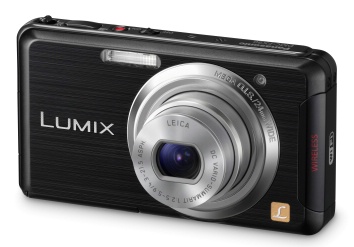
    Why leave out on Android and iOS when the whole world is playing? Panasonic has released the new Lumix FX90 which not only feature a built in Wireless antenna but also a Android and iOS app from Launch. These apps allow transferring pictures and video directly to a mobile device, then uploading them to Lumix Club — a cloud-based photo-sharing service — and on to Twitter, Facebook, YouTube, etc. 

    Main Specs include

    • 12 megapixel CCD sensor
    • 5x, 24-120mm optical zoom lens
    • 3-inch touchscreen
    • 1080i AVCHD video capture
    • Facebook and Twitter Integrations
    • Dedicated iOS and Android Apps
    [toggle title_open=”Collapse Press Release” title_closed=”Press Release” hide=”no” border=”yes” style=”default” excerpt_length=”0″ read_more_text=”Read More” read_less_text=”Read Less” include_excerpt_html=”no”]PANASONIC ADDS WI-FI® CONNECTIVTY TO THE NEW LUMIX FX90 STYLISH COMPACT DIGITAL CAMERA

    With Wi-Fi Connectivity LUMIX FX90 Easily Shares Photos Via Popular Social Networks Direct from Compatible Smartphones

    SECAUCUS, NJ (August 26, 2011) – Panasonic today announces a new stylish compact digital camera, the LUMIX DMC-FX90, which adds Wi-Fi® connectivity (802.11 b/g/n) to a high-performing and feature-rich model that boasts a 24mm ultra-wide LEICA DC VARIO-SUMMARIT lens with F2.5 brightness. With the addition of the Wi-Fi connectivity, the LUMIX FX90 addresses the growing communities of people who take photos and videos and want to share them instantly via online social networks.

    Panasonic also introduces today LUMIX CLUB, a cloud-based service that is accessible via a smartphone and a computer browser that allows consumers to upload photos taken with the LUMIX FX90 to the following social networks: Facebook™, Flickr™, Picasa™ or YouTube™. Photos can even be shared with these sites simultaneously, making it easy and quick. Additionally, once a LUMIX CLUB account is acquired, Panasonic will also provide a free, dedicated application called “LUMIX LINK”, which will be compatible with iPhone® and Android™OS smartphones, thus consumers can instantly share photos by connecting the LUMIX FX90 just once to their compatible smartphone and then using the carrier network to share photos online. After the initial set-up, sharing photos will be as simple as using the LUMIX LINK application on the smartphone.

    “The FX90 is a digital camera packed with high-end imaging features, enabling consumers to take photos and videos that they are proud to share with friends and family, as well as archive to preserve their memories,” said Darin Pepple, Senior Product Manager, Imaging, Panasonic Consumer Electronics Company. “With the FX90’s Wi-Fi connectivity capabilities, users can now share these photos instantly on popular social networks via an iPhone or Android OS-based smartphones. Sharing photos online is one of the biggest trends now and Panasonic believes image quality does not have to be comprised. With the FX90’s incredible F2.5 lens, photos will be crisp and clear, even when taken indoors with poor lighting. And with its sleek body and extremely fast Auto Focusing, the FX90 is the ideal digital camera to capture all of life’s moments – big and small.”

    Using the LUMIX LINK application, users can enter and store all their social network account information and will not have to log-in to individual sites after the initial set-up. At home, users can directly upload the images to the social networks via the access point of a home router or a wireless connection. To make accessing Wi-Fi even easier, the LUMIX FX90 has a convenient dedicated Wi-Fi button that when pressed, directly opens a Wi-Fi Connection mode outside home and gets WPS (Wi-Fi Protected Setup) connection at home. The Wi-Fi module is located on the opposite side of the grip so as not to interfere with the connection signal.

    In addition to its Wi-Fi connectivity features, the LUMIX FX90 is an outstanding digital camera complete with a stylish design and sleek body. With an ultra-wide-angle Leica lens complete with a 5x optical zoom (available also in video recording) and an F2.5 brightness, the LUMIX FX90 excels in a variety of shooting environments. Whether taking a photo of a landscape, or capturing moving subjects even in low-lit situations – the LUMIX FX90’s outstanding lens will take the photo brightly and crisply.

    The LUMIX FX90 also features a 3.0-inch 460,000-dot LCD with Smart Touch, meaning all controls can be made by intuitively touching the screen. Touch operations while recording, include: Touch AF, Touch Zoom or Touch Shutter. And during playback, the Smart Touch feature can be used with the Beauty Retouch and Art Retouch modes. In addition, functions and settings used most often, such as O.I.S., AF point and white balance, can easily be customized to the user and accessed via the shortcut setting by dragging the icon to the main menu.

    The LUMIX FX90’s outstanding performance is powered by a 12.1-megapixel Hi-Speed CCD sensor and is compatible with high-speed, large-capacity signal processing required for 1920 x 1080 60i (sensor output 30p) full-HD video recording in the AVCHD format. Videos can also be recorded in MPEG4 format to easily playback on a computer and other portable electronic devices. To complement its high-quality video capabilities, the LUMIX FX90 also includes Dolby Digital Creator to record high quality audio. The Venus Engine powers the Sonic Speed AF, enabling extremely fast start-up times, making the LUMIX FX90 not only a powerful digital camera, but a speedy one, too. Also, the Venus Engine also provides precisely selective noise reduction to the chromatic noise without affecting the border of colors, so images are naturally clear and crisp in both photo and video recording.

    Like all of Panasonic’s digital cameras, the LUMIX FX90 features Intelligent Auto. When in iA mode, the LUMIX FZ47 automatically chooses the best setting based on the shooting environment and features include: Active Mode in MEGA O.I.S. (Optical Image Stabilization), Motion Deblur*, Face Recognition, Face Detection, AF Tracking, Intelligent ISO Control and Intelligent Scene Selector and Intelligent Exposure. Even when shooting video, the LUMIX FX90 enables the following features when in iA: AF Tracking, MEGA O.I.S., Face Detection, Intelligent Scene Selector and Intelligent Exposure – all available to help take clear videos worthy of sharing with friends and family.

    Access to the LUMIX CLUB is expected, be available on September 5, 2011 here:

    http://lumixclub.panasonic.net and will allow consumers to easily share their images on Facebook, Flickr, Picasa or YouTube. In addition the LUMIX LINK applications for iPhone and Android OS smartphones will be also available. The LUMIX CLUB site will available in six languages: English, Italian, German, French, Spanish and Japanese. In the future, LUMIX CLUB plans to add the following features:

    • A storage service so photos can be uploaded to an album that resides in the cloud-based networks and then viewed from smartphones, and Internet-enabled Panasonic VIERA HDTVS and Blu-ray Disc players
    • An intuitive user interface with a Timeline function that has a drag-and-drop feature
    • A photo sharing album function that will allow users who attended the same event, such as a wedding or party, to exchange and comment on photos and videos

    Pricing and availability for the LUMIX FX90 will be announced approximately 30 days prior to shipping. For more information about Panasonic LUMIX digital cameras, please visit www.panasonic.com/lumix.[/toggle]

  • The Oppopet Mouse

    The Oppopet Mouse

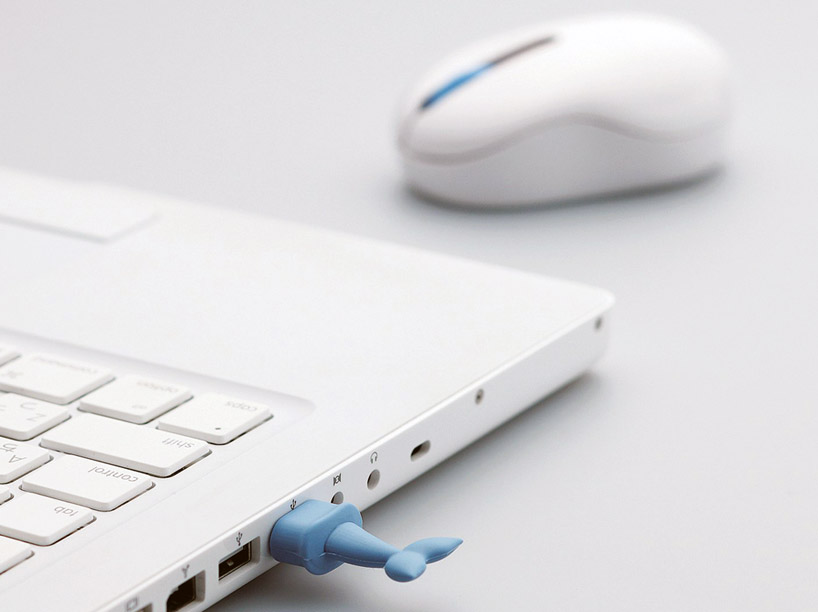
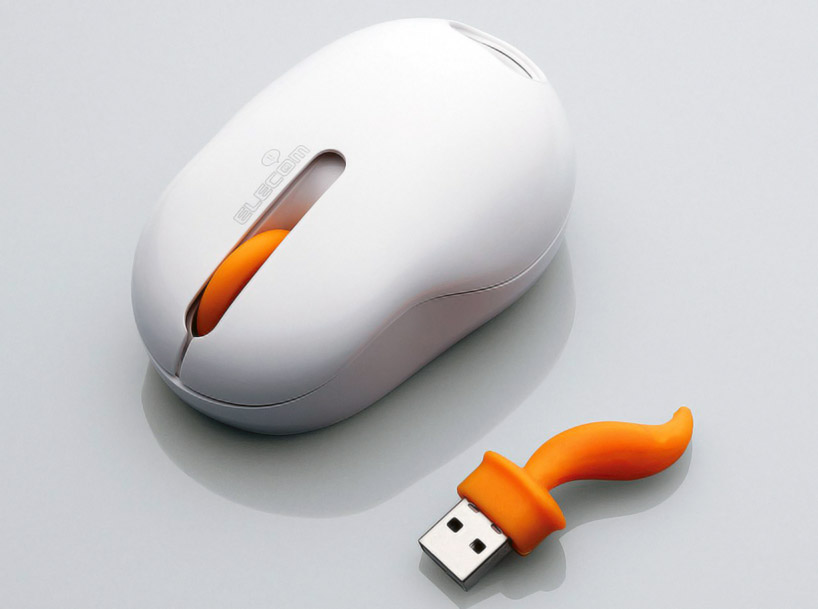
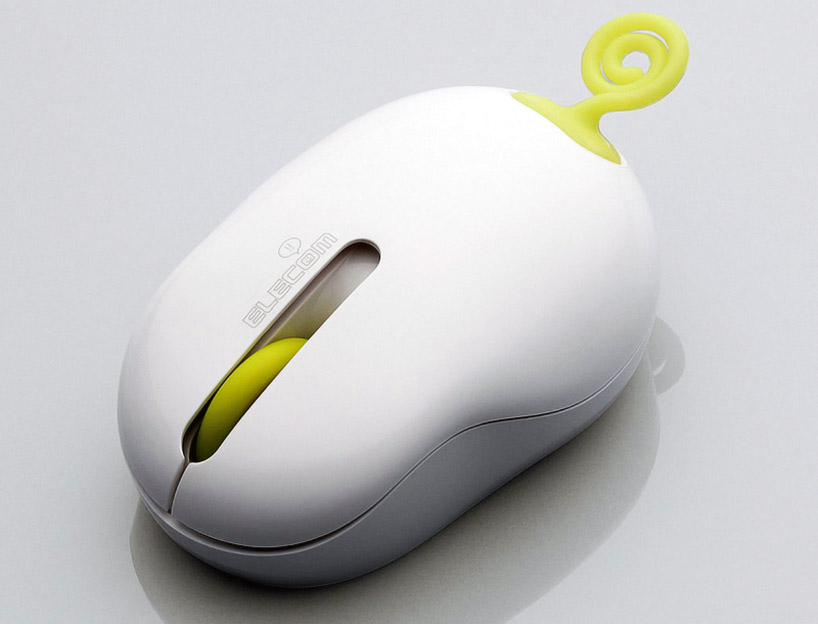
    The Oppopet series of wireless mice is produced by Elecom in collaboration with Nendo. Whats nice about these mice is that the designers have taken a traditional mouse and given it a new persona. Instead of having a regular receiver, these mice have receivers shaped like the tail of an animal, making the devices appear like small pets. While they were announced last year, the devices have just been launched in Japan.

    Oppopet requires no drivers and can be used simply by plugging the tail into a free USB port on your desktop or laptop. Equipped with an on-off switch, the 2.4GHz, 3-button optical mouse weighs 55 grams and runs on a single AAA battery. It is produced in models including a fox, dog, dolphin, cat, pig, squirrel, chameleon, and rabbit. Check out the pictures below. We already want one.


  • Printable Antenna Generates Electricity from Out of the Blue

    Printable Antenna Generates Electricity from Out of the Blue

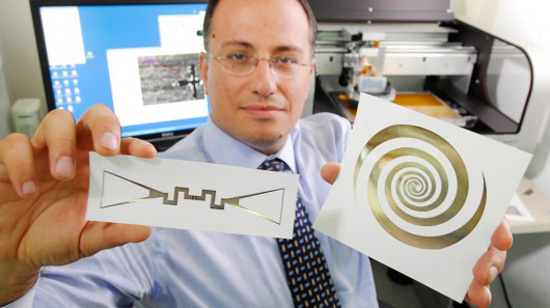
    WiFi networks, Cellphone and Radio Signals. These are just a few of the waves that are spamming the Electro Magnetic Spectrum around you most of the time. You can harvest this energy for more than its intended use. With printable antennas, you can power battery free electronics in most urban environments.

    Since this technology is still in its infancy and generates only a few milliwatts, so don’t expect it to power your cellphone or laptop anytime soon. What this technology is good for is powering networks of sensors in locations that don’t have electrical outlets, batteries or access to solar power. This could be a temperature sensor placed in the wall of your home, or a sensor built into the body of your car to check for structural damage. These sensors could also be teamed up with capacitors to collect power and send short bursts of wireless data to a receiver nearby.

    Theoretically, the amount of electricity generated could be increased in two ways. The first way would involve stacking these antennas one on top of the other and the second way would be to increase the surface area of each antenna. Combined, perhaps we could have a self charging battery or phone in the near future. We can only hope…

  • Apple May release an iPod Touch 3G, Data only

    Apple May release an iPod Touch 3G, Data only


    Looks like Apple might bring a total of three new things to the Table this September. New iPhone 5, revised iPad 2 ( 3) and a totally new iPod 3g?. Yes you read it right, several sources including a dutch website claim that Apple will release a 3G iPod touch this year. Similar to the iPad , the iPod touch 3G will only be able to use the onboard radio for data connectivity and not to make phone calls. 

    But we know there is always a work around for that, right?

    So essentially a total of three totally revamped iOS devices are heading your way in September. We sure hope you start saving up!

    [Read]
iGyaan Network
Privacy Overview

This website uses cookies so that we can provide you with the best user experience possible. Cookie information is stored in your browser and performs functions such as recognising you when you return to our website and helping our team to understand which sections of the website you find most interesting and useful.