Tag: industry

  • Google working on several Nexus devices for Android 5.0, Tablet in tow

    Google working on several Nexus devices for Android 5.0, Tablet in tow

    Looks like Google is planning to release a series of Nexus devices this year, including some tablets, on Google Android 5.0. The Wall Street Journal is reporting that Google is planning to partner with a variety of OEMs (in order to have up to five Pure Google Nexus devices available at once. All of these devices will ship with Android 5.0 Jelly bean

    This move is likely to be announced at the next Google I/O conference.

    [WSJ]

  • Apple Q2 Earnings show net profit of $11.6 billion, $39.2 billion in revenue

    Apple Q2 Earnings show net profit of $11.6 billion, $39.2 billion in revenue

    Talk about big bucks, while companies stubble to hit the million mark, Apple continues to show good results Quarter over Quarter. The new numbers rank in at US $ 39.2 Billion in Revenue for the company , with upwards of 30 million iPhones sold and 12 million iPads sold.

     The new $12.30 earnings per share, compared to an estimated $10.04 earnings per share – adds up to $39.2 billion in revenue and $11.6 billion in profit. The iPhone sales show an 88% growth from the previous years quarter and the iPad sales show a whopping 151% increase over the last years same quarter. 

    Apple also sold over 4 million Mac units, making it a 7 % increase, with the same quarter last year.


    We’re thrilled with sales of over 35 million iPhones and almost 12 million iPads in the March quarter. The new iPad is off to a great start, and across the year you’re going to see a lot more of the kind of innovation that only Apple can deliver.”

    -Tim Cook , CEO Apple

    In a comparison with the last 2 years, Apple’s profits ar double compared to Q2 2011, and Four times compared to Q2 2010.

    [Apple]

  • Gartner: Apple leads, Android level dips

    Gartner: Apple leads, Android level dips

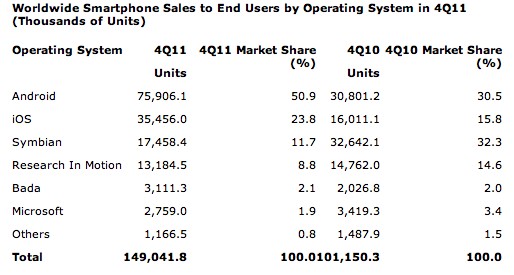
    According to a recent report by Gartner Apple leads as the world’s top smartphone vendor by market share (19 percent), majorly thanks to the holiday quarter. During the season Apple sold some 35.5 million handsets to end users, a 121.4 percent increase from Q4 2010.

    Apple now also overtook LG as the Third largest seller of mobile handsets with 7.4 percent market share in the past holiday quarter right behind Nokia (23.4 percent) and Samsung (19.4 percent).


    [box style=”rounded” border=”full”]

    Gartner Says Worldwide Smartphone Sales Soared in Fourth Quarter of 2011

    Apple Became Top Smartphone Vendor in Fourth Quarter of 2011 and in 2011 as a Whole

    Egham, UK, February 15, 2012-

    Worldwide smartphone sales to end users soared to 149 million units in the fourth quarter of 2011, a 47.3 per cent increase from the fourth quarter of 2010, according to Gartner, Inc. Total smartphone sales in 2011 reached 472 million units and accounted for 31 percent of all mobile devices sales, up 58 percent from 2010.

    Smartphone volumes during the quarter rose due to record sales of Apple iPhones. As a result, Apple became the third-largest mobile phone vendor in the world, overtaking LG. Apple also became the world’s top smartphone vendor, with a market share of 23.8 percent in the fourth quarter of 2011, and the top smartphone vendor for 2011 as a whole, with a 19 percent market share. “Western Europe and North America led most of the smartphone growth for Apple during the fourth quarter of 2011,” said Roberta Cozza, principal research analyst at Gartner. “In Western Europe the spike in iPhone sales in the fourth quarter saved the overall smartphone market after two consecutive quarters of slow sales.”

    The quarter saw Samsung and Apple cement their positions further at the top of the market as their brands and new products clearly stood out. LG, Sony Ericsson, Motorola and Research In Motion (RIM) again recorded disappointing results as they struggled to improve volumes and profits significantly. These vendors were also exposed to a much stronger threat from the midrange and low end of the smartphone market as ZTE and Huawei continued to gain share during the quarter.

    Worldwide mobile device sales to end users totaled 476.5 million units in the fourth quarter of 2011, a 5.4 percent increase from the same period in 2010 (see Table 1). In 2011 as a whole, end users bought 1.8 billion units, an 11.1 percent increase from 2010 (see Table 2). “Expectations for 2012 are for the overall market to grow by about 7 percent, while smartphone growth is expected to slow to around 39 percent,” said Annette Zimmermann, principal research analyst at Gartner.

    In the fourth quarter of 2011, Nokia’s mobile phone sales numbered 111.7 million units, an 8.7 percent decrease from last year. “Samsung closed the gap with Nokia in overall market share,” said Ms. Cozza. “Samsung profited from strong smartphone sales of 34 million units in the fourth quarter of 2011. The troubled economic environment in Europe and Nokia’s weakened brand status posed challenges that were hard to overcome in just one quarter. However, Nokia proved its ability to execute and deliver on time with its new Lumia 710 and 800 handsets. Nokia will have to continue to offer aggressive prices to encourage communications service providers (CSPs) to add its products to portfolios currently dominated by Android-based devices.”

    Apple had an exceptional fourth quarter, selling 35.5 million smartphones to end users, a 121.4 percent increase year on year. Apple’s continued attention to channel management helped it take full advantage of the strong quarter to further close the gap with Samsung, which saw some inventory build up for its smartphone range. Apple’s strong performance will continue into the first quarter of 2012 as availability of the iPhone 4S widens. However, since Apple will not benefit from delayed purchases as it did in the fourth quarter of 2011, Gartner analysts expect its sales to decline quarter-on-quarter.

    After Apple, ZTE and Huawei were the fastest-growing vendors in the fourth quarter of 2011. “These vendors expanded their market reach and kept on improving the user experience of their Android devices,” said Ms. Cozza.

    In the fourth quarter of 2011, ZTE moved into fourth place in the global handset market. ZTE posted a strong smartphone sales increase of 71 percent sequentially. The company was able to extend its portfolio to three CSPs in its home market and benefited from consumers’ interest in low-cost smartphones. Huawei moved ahead of LG in the Android marketplace to become a top-four Android manufacturer, thanks to strong smartphone growth in the quarter. Huawei has made significant progress in moving to its own-branded devices, and it has continued to expand its portfolio into higher tiers as its tries to build more iconic products.

    RIM dropped to the No. 7 spot in the fourth quarter of 2011, with a 10.7 percent decline. RIM’s delay with its BlackBerry 10 platform will further impair its ability to retain users. However, RIM’s biggest challenge is still to expand the developer base around its ecosystem and convince developers to work and innovate with BlackBerry 10.

    In the smartphone OS market (see Table 3), competition between Google and Apple intensified. Android’s share declined slightly sequentially. This was due to strong iPhone sales, driven in particular by the iPhone 4S in mature markets and the weakness of key Android vendors as they struggled to create unique and differentiated devices. Samsung remained the main contributor to Android share gains in the second half of 2011. iOS’s market share grew 8 percentage points year-on-year, but Gartner analysts expect Apple’s share to drop in the next couple of quarters as the upgrade cycle to the iPhone 4S slows. Nokia’s first Windows Phone smartphones, the Lumia 710 and 800, made their debut, but, as expected, sales were not enough to prevent a fall in Microsoft’s smartphone market share.[/box]
  • China government Ban on iPad causes removal of stocks from stores.

    China government Ban on iPad causes removal of stocks from stores.

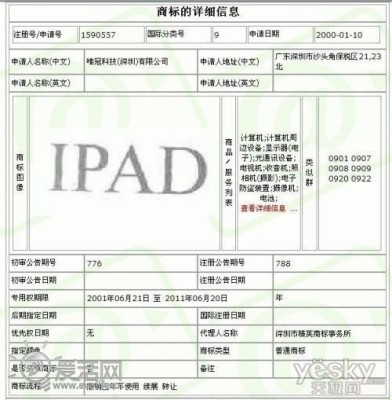
    Government authorities and retailers in China have started removing stocks of iPad from the shelves in the market,  in response to a ruling issued in December. According to Hebei Youth Daily, local representatives of the country’s Administrations of Industry and Commerce (AIC) have started confiscating Apple’s tablet from retail outlets, with some merchants are voluntarily removing the device from their storefronts as a pre-emptive measure. 

    As a part of a local campaign this incident only  took place in the city of Shijiazhuang, but vendors weary of the outcome have started to take precautions. Remember this is the same country where people literally give body parts to own iPads.

  • Yummy : A 3D Printer that works on Chocolate

    Yummy : A 3D Printer that works on Chocolate

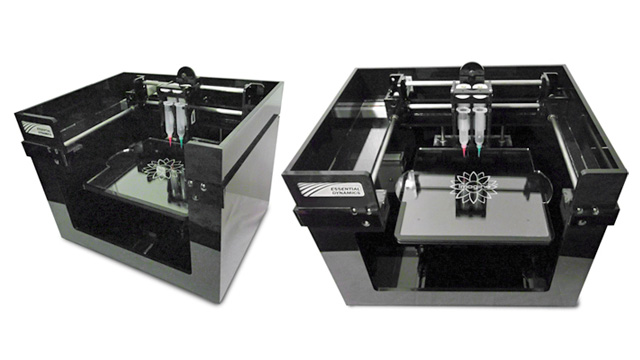
    Imagine 3D printer is the first of its kind 3D printer, instead of meted plastic this printer can make 3D objects using molten chocolate in its syringes. 3D printing is the next step in the Industry especially with its advancements every day. Using a 3D printer to make items in chocolate could actually change to way people celebrate functions or festivals. The printer has other capabilities and in addition to chocolate, the syringes can also be filled with cheese, epoxy, silicone, and even concrete for those permanent casts.

    [box style=”rounded” border=”full”]

    Wiki

    3D printing is a phrase used to describe the process of creating three dimensional objects from digital file using a materials printer, in a manner similar to printing images on paper. The term is most closely associated with additive manufacturing technology, where an object is created by laying down successive layers of material. Recently the term is increasingly being used to describe all types of additive manufacturing processes, or even other types of rapid prototyping technology.

    Since 2003 there has been large growth in the sale of 3D printers. Additionally, the cost of 3D printers has gone down.The technology also finds use in the fields of jewelry, footwear, industrial design, architecture, engineering and construction (AEC), automotive, aerospace, dental and medical industries, education, geographic information systems, civil engineering, and many others.

    [/box]

    [ED]

  • Samsung to borrow 1 Billion US dollars to expand capacity in Texas

    Samsung to borrow 1 Billion US dollars to expand capacity in Texas

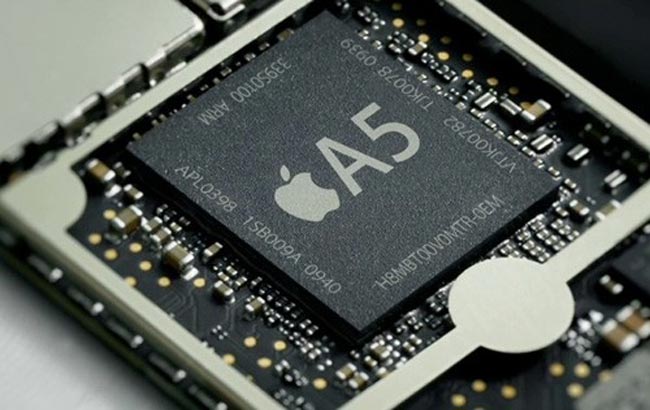
    Samsung Semiconductor makes main processor chips for iPhones, iPad’s and many other tablets and smartphones from other vendors including Samsung Mobiles. To meet with the exceeding demand for these products the supply of the said chips needs to be in order. Bloomberg is reporting that Samsung Semiconductor has “sent requests for proposals to banks to borrow as much as $1 billion to expand production capacity at its factory in Austin, Texas,” with the bonds to be issued by Samsung’s United States unit.

    The company which is about US $ 20 Billion cash rich will sell its bonds first time since 1997, due to the low borrowing rate. The company plans to utilize this money to boost production of mobile phone processor and GPU chips as well as invest in innovation in their OLED manufacturing.

    [Bloomberg]

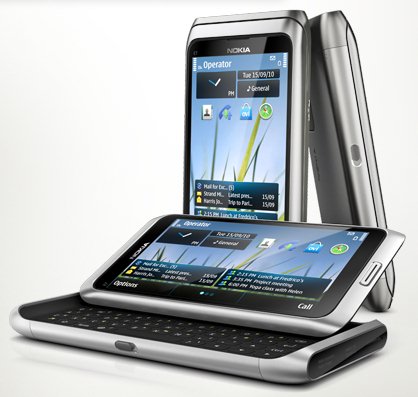
  • Nokia acquires mobile OS Smarterphone

    Nokia acquires mobile OS Smarterphone

    Nokia is playing around with a lot of operating systems on its plate. Symbian, MeeGo, Series 60 and not to forget WindowsPhone. The company has now gone and acquired the mobile OS known as Smarterphone. Ferd Capital has sold Smarterphone AS to Nokia, back in November 2011. The company claims that it makes ultra-smart mobile operating system software for featurephones, enabling users to get a smartphone-like experience on “affordable hardware.” 

    No official plans for the utilization of the OS have been given out by either Ferd Capital or Nokia. Butm an OS like this would do brilliantly in developing countries like India, where feature phones are still the most selling handsets.

    [Ferd Capital]

  • Apple acquires Anobit for $500 million, will set up R&D in Israel

    Apple acquires Anobit for $500 million, will set up R&D in Israel


    Apple has consumed yet another piece of the puzzle in a bid to have all in-house manufacturing. Apple uses all Nand Flash storage in their iDevices, including iPod, iPad and the iPhone, an acquisition of a company that manufacturers this storage was an obvious step from the self sustained giant.  Apple has bought Anobit for a straight sum of US $ 500 million, with aims to lower costs and improve efficiency in their manufacturing process.

    [threecol_one_last]

    “Welcome to Israel, Apple Inc. on your [first] acquisition here. I’m certain that you’ll benefit from the fruit of the Israeli knowledge.”

     [/threecol_one_last][threecol_two_last]

    Apple is also planning to set up its first off-US Research & Development lab in Israel, with no confirmations from either sides of the deal. Apple is expected to come clean in its next financial report, where it shall disclose billions of dollars in earnings and some million spending.

    [/threecol_two_last]

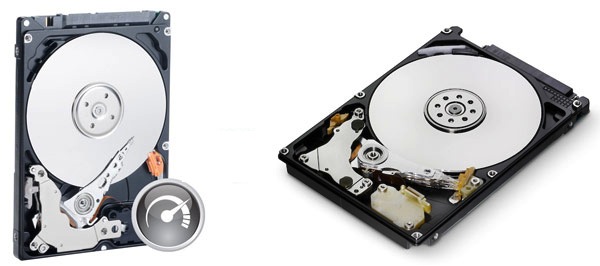
  • Western Digital acquires Hitachi GST for $4.3 Billion

    Western Digital acquires Hitachi GST for $4.3 Billion

    WD is one of the worlds best hard drive manufacturing and selling companies and they have just announced a deal  to acquire one of its primary competitors, Hitachi Global Storage Technologies Steve Milligan, president and chief executive officer of Hitachi GST, will join WD at closing as president. In the deal the acquisition will include $3.5 billion in cash and $750 million in WD common stock.

    The takeover is said to be finalized by Q3 2011.


    Official Press


    Western Digital to Acquire Hitachi Global Storage Technologies

    Combination of Hard Drive Companies Will Create Industry’s Broadest Product Portfolio and a Significant Pool of Resources for Innovation

    IRVINE, Calif. and SAN JOSE, Calif., March 7, 2011 /PRNewswire-FirstCall/ — Western Digital (NYSE: WDC) and Hitachi, Ltd. (NYSE: HIT / TSE:6501) announced today that they have entered into a definitive agreement whereby WD will acquire Hitachi Global Storage Technologies (Hitachi GST), a wholly-owned subsidiary of Hitachi, Ltd., in a cash and stock transaction valued at approximately $4.3 billion. The proposed combination will result in a customer-focused storage company, with significant operating scale, strong global talent and the industry’s broadest product lineup backed by a rich technology portfolio.

    Under the terms of the agreement, WD will acquire Hitachi GST for $3.5 billion in cash and 25 million WD common shares valued at $750 million, based on a WD closing stock price of $30.01 as of March 4, 2011. Hitachi, Ltd. will own approximately ten percent of Western Digital shares outstanding after issuance of the shares and two representatives of Hitachi will be added to the WD board of directors at closing. The transaction has been approved by the board of directors of each company and is expected to close during the third calendar quarter of 2011, subject to customary closing conditions, including regulatory approvals. WD plans to fund the transaction with a combination of existing cash and total debt of approximately $2.5 billion.

    WD expects the transaction to be immediately accretive to its earnings per share on a non-GAAP basis, excluding acquisition-related expenses, restructuring charges and amortization of intangibles.

    The resulting company will retain the Western Digital name and remain headquartered in Irvine, California. John Coyne will remain chief executive officer of WD, Tim Leyden chief operating officer and Wolfgang Nickl chief financial officer. Steve Milligan, president and chief executive officer of Hitachi GST, will join WD at closing as president, reporting to John Coyne.

    “The acquisition of Hitachi GST is a unique opportunity for WD to create further value for our customers, stockholders, employees, suppliers and the communities in which we operate,” said John Coyne, president and chief executive officer of WD. “We believe this step will result in several key benefits-enhanced R&D capabilities, innovation and expansion of a rich product portfolio, comprehensive market coverage and scale that will enhance our cost structure and ability to compete in a dynamic marketplace. The skills and contributions of both workforces were key considerations in assessing this compelling opportunity. We will be relying on the proven integration capabilities of both companies to assure the ongoing satisfaction of our customers and to bring this combination to successful fruition.”

    “This brings together two industry leaders with consistent track records of strong execution and industry outperformance,” said Steve Milligan, president and chief executive officer, Hitachi Global Storage Technologies. “Together we can provide customers worldwide with the industry’s most compelling and diverse set of products and services, from innovative personal storage to solid state drives for the enterprise.”

    Hiroaki Nakanishi, president, Hitachi, Ltd. said, “As the former CEO of Hitachi GST, I always believed in the potential of Hitachi GST to become a larger and more agile company. This is a strategic combination of two industry leaders, both growing and profitable. It provides an opportunity for the new company to increase customer and shareholder value and expand into new markets. Additionally, it is important to us that WD shares common values with Hitachi GST to create a more global company that is well positioned to define a broader role in the evolving storage industry.”

    WD’s exclusive financial adviser on the transaction is Bank of America Merrill Lynch; its lead legal adviser is O’Melveny & Myers LLP. Goldman, Sachs & Co serves as financial adviser to Hitachi, Ltd. and Hitachi GST. Legal advisers to Hitachi, Ltd. and Hitachi GST are Morrison Foerster LLP and Skadden, Arps, Slate, Meagher & Flom LLP & Affiliates, respectively.

iGyaan Network
Privacy Overview

This website uses cookies so that we can provide you with the best user experience possible. Cookie information is stored in your browser and performs functions such as recognising you when you return to our website and helping our team to understand which sections of the website you find most interesting and useful.